Building Better Chrome Extensions: From Concept to Launch (The Playbook Tutorials Skip)
person Patrick Bushe · calendar_today April 30, 2026
SEO Title: Building Better Chrome Extensions: From Concept to Launch (2026)
Meta Description: A working developer's playbook for shipping a Chrome extension in 2026 — pre-launch validation, MV3 gotchas, Web Store review pitfalls, and the growth loop.
Most "build a Chrome extension" tutorials end the moment you click Load Unpacked and see your popup render. That's the easy part. The hard parts are everything that comes after: idea validation, the MV3 traps that ate two weeks of my life, Chrome Web Store review rejections, getting your first 100 users, and the maintenance loop that keeps an extension alive past month six.
I've shipped ten extensions on the Chrome Web Store. Three are at 4.9 stars with thousands of weekly users. Two were rejected on first submission. One was pulled and rewritten because I made an MV3 mistake that didn't show up in local testing. This is the playbook I wish I'd had on day one.
Phase 1: Concept Validation (Skip This and You'll Build the Wrong Thing)
The Chrome Web Store has roughly 180,000 extensions. Most of them have under 100 users. The reason isn't always quality — it's that the developer built something nobody was searching for.
Before writing a line of manifest.json, do three things:
1. Search the Web Store for your idea.
Use the keywords a user would type. If 20 extensions already do what you're planning, ask: what does mine do that the top 3 don't? "Better UX" is not an answer — Chrome users don't switch extensions for UX, they switch for missing features or trust.
2. Read the 1- and 2-star reviews on the top competitors.
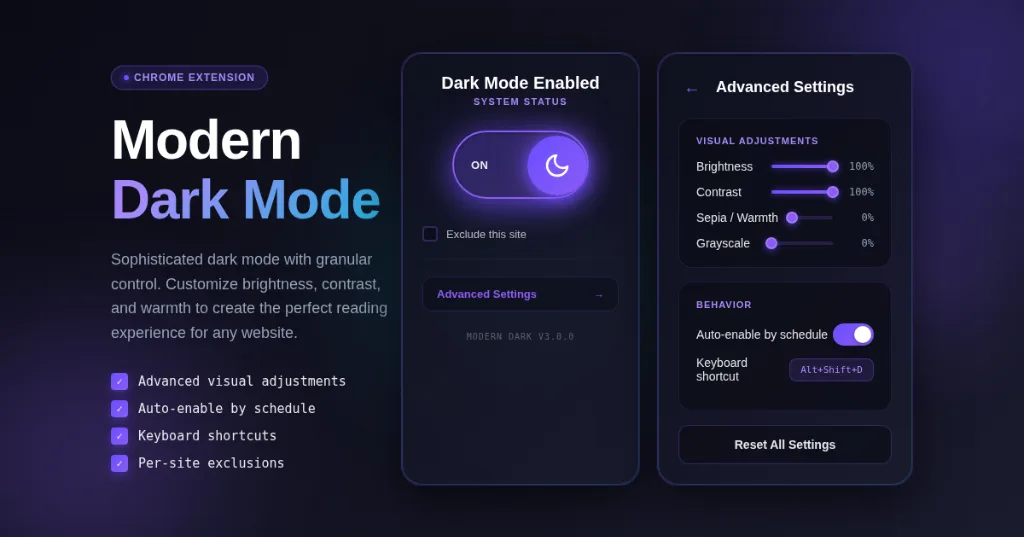
This is where the gold is. Negative reviews tell you exactly which features are missing, which permissions users hate, and which workflows break. Modern Dark Mode existed because the top 5 dark-mode extensions all inverted images, and every one of them had reviews complaining about it. I built one that didn't.
3. Ask: would I pay $5/month for this?
You probably won't charge for it. But the answer tells you whether the value is real. If you wouldn't pay for it, neither will anyone else, and a free extension that nobody installs is the same as no extension.
Phase 2: MV3 Architecture (The Traps Tutorials Don't Mention)
Manifest V3 is mandatory in 2026, and most tutorials hand you a manifest.json template without explaining the architectural shift. Here's what actually changed and where it bites:
Service worker, not background page.
Your background script is now an event-driven service worker. It can be killed at any time, and it will be killed roughly 30 seconds after its last event. Anything you stored in a module-level variable will vanish. State has to live in chrome.storage.session or chrome.storage.local, not in memory.
No webRequest blocking — use declarativeNetRequest.
If you're building an ad blocker, content blocker, or anything that intercepts network requests, you can no longer make blocking decisions at runtime. You declare rules ahead of time in JSON, and Chrome enforces them. This is the single biggest reason uBlock Origin (full version) is no longer available on Chrome.
No remote code.
You can't load eval(), you can't fetch() a remote <script> and inject it. Every line of executable code must ship inside your extension package. This breaks a lot of "AI sidebar" extensions that load logic dynamically — Web Store reviewers will reject them on sight.
Content scripts run in an isolated world by default.
If you need to access page-level JavaScript variables, you have to inject a <script> tag with chrome.scripting.executeScript({ world: 'MAIN' }). The defaults changed in MV3 and a lot of MV2 tutorials still get this wrong.
Trap I personally fell into: I had a service worker that registered a chrome.alarms.create() listener inside an async function. The service worker died, woke up on the alarm, and the listener wasn't registered yet because Chrome hadn't finished re-running the top of the file. Every alarm event was lost. Lesson: register every listener at the top level of your service worker, synchronously, not inside async blocks or chrome.runtime.onInstalled callbacks.
Phase 3: Build for Permissions Minimalism
Every permission you request makes the install warning scarier and the Web Store review longer. Audit your permissions before submission:
| Permission | When you actually need it |
|-----------|---------------------------|
|
| activeTab | The user clicks your icon and you act on the current tab — preferred default |
| tabs | You need tab IDs/URLs without user action — justify carefully |
| storage | Persisting user prefs — almost always needed |
| scripting | Injecting into pages — pair with activeTab not
| webNavigation | Tracking page transitions — often replaceable with content script onload |
| cookies | Reading/writing cookies — review will scrutinize this |
| clipboardRead | Reading clipboard — Web Store will ask why |
Rule of thumb: if you can replace activeTab, do it. Your install rate will go up because the install warning becomes "This extension can read and change data on the site you're currently on" instead of "...on all websites." Users notice that difference.
Phase 4: Local Testing That Catches Real Bugs
Loading your extension via chrome://extensions → Load Unpacked is the start, not the test plan. Three things I do for every release:
AI Consulting
Want AI Results, Not Hype?
Get practical AI strategy and implementation support for your business.
Explore AI ConsultingRecommended Extension
Modern Dark Mode
Modern Dark Mode is a free Chrome extension that adds dark mode to any website using intelligent CSS filter inversion. Preserves images and ...
Open in Chrome Web Store1. Test in Incognito. Most extensions break in Incognito because storage behaves differently and some APIs are gated. Toggle "Allow in Incognito" in the extension details page and run your full flow.
2. Test with another extension already installed. Specifically uBlock and Bitwarden — they hook into the page in ways that can collide with content scripts. If you're injecting CSS, watch the cascade order. If you're listening for keydown, watch for stopPropagation.
3. Test cold-start latency. Open Chrome's Task Manager (Shift+Esc) and watch your extension's memory and CPU on first load. If your service worker takes 200ms+ to wake up, users will notice on every keypress.
Phase 5: Chrome Web Store Submission (Where Tutorials End and Reality Starts)
The submission flow is the usual upload-zip-and-fill-the-form, but the parts that get extensions rejected are:
Single-purpose policy.
Your extension must do one thing. "AI assistant + screenshot tool + password manager" gets rejected. Pick a single purpose and put it in the listing description verbatim. If you have multiple features, justify each as a sub-feature of the single purpose.
Permission justification.
Every permission you request must be justified in the dashboard, in plain English, with a concrete user story. "We need
Privacy disclosure.
You'll fill out a data-handling form. If your extension sends anything off-device — analytics, error reporting, AI API calls — disclose it. Reviewers cross-reference network traffic. Lying here is the fastest way to get a permanent ban.
Screenshots and listing copy.
Five 1280×800 screenshots. Use real product UI, not mockups. Reviewers reject listings where the screenshots don't match what the extension actually does.
Review timeline: 2-5 business days for a first submission, usually under 24 hours for updates. Expect at least one back-and-forth on the first submission.
Phase 6: The Growth Loop
You shipped. Now nobody knows it exists. The growth flywheel for an extension is different from a SaaS product:
Reviews are everything. Chrome Web Store search ranks heavily on rating and review count. A 4.9-star extension with 50 reviews outranks a 4.7-star with 5,000. Politely ask early users to rate. Don't beg, don't gate the feature on a review — Google will ban you.
SEO is real. People search Google for "dark mode chrome extension," not the Chrome Web Store. Build a landing page, write content that targets the long-tail of your category, and link to your Web Store listing. About 30% of my install traffic is organic Google search.
Update cadence signals life. An extension that hasn't shipped an update in 9 months loses ranking. Ship at least quarterly, even if it's a minor refactor.
Respond to every 1- and 2-star review. Often the user has a real bug. Fix it, ship the update, and reply to the review with the version number that fixed their issue. Some users update their rating. All future readers see that you respond.
What I Wish I'd Known on Day One
Three lessons that compounded across all 10 extensions I shipped:
1. Boring, focused extensions outperform impressive Swiss-army-knife ones. Modern Dark Mode does one thing. AutoBrowser does one thing. They both have higher retention than my "all-in-one" attempts.
2. Permission audit before shipping, not during review. I now run a permission diff against the previous version on every release and force myself to justify any new entry.
3. The first 100 users are a focus group, not a launch. Treat their bug reports as the most valuable signal you'll ever get and ship fixes within 48 hours. Those users become your reviewers.
Frequently Asked Questions
Q: Do I need a framework like React for a Chrome extension?
A: No, and most production extensions don't use one. Vanilla JS keeps your bundle small and your service worker fast. I ship all my extensions with no framework, no build tools — just HTML, CSS, JS, and the manifest.
Q: How long does it take to build a Chrome extension?
A: A working MVP: a weekend. A polished, Web Store-ready extension: 2-4 weeks for first-timers. That's not coding time — most of it is testing edge cases, writing the listing, and handling review feedback.
Q: Can I monetize a Chrome extension?
A: Yes, but it's hard. Common models: paid tier with feature gating, optional license key, donation. Avoid ads — Chrome Web Store policy on ad-injection is strict and you'll likely be removed.
Q: What's the most common reason for first-submission rejection?
A: Permission justification. Reviewers want to see exactly which feature each permission enables, in user-facing language. Generic justifications fail.
Keep Going
If you want to dive deeper into the privacy side, I wrote about the Top 10 Privacy-Focused Chrome Extensions in 2026 — a useful frame for understanding what users expect from your data-handling. For the AI side, see How AI Is Transforming Browser Extensions in 2026 — Chrome's built-in AI APIs change what you can build without sending data to a server.
Or browse my own extensions — every one is open about its permissions and ships MV3-native.
Patrick Bushe is a digital product designer and Chrome extension developer based in Los Angeles. He has shipped 10+ extensions on the Chrome Web Store. Find him at bushe.co.