Expert Picks: 12 Cutting-Edge Chrome Extensions for 2026 (From a Developer Who's Shipped 10+)
person Patrick Bushe · calendar_today April 30, 2026
SEO Title: Expert Picks: 12 Cutting-Edge Chrome Extensions for 2026
Meta Description: A Chrome extension developer's 12 cutting-edge picks for 2026, with permission audits, MV3 status, and the categories worth skipping. Built from real shipping experience.
I build Chrome extensions for a living. Over the past three years I've shipped ten of them — Modern Dark Mode, AutoBrowser, Search Cleaner, Ghost Browser, Sticky Notes Anywhere, and more — across the Chrome Web Store. That means I read manifests for fun, I argue about host_permissions on weekends, and I have strong opinions about which of my 70+ installed test extensions actually deserve a permanent slot.
Most "best Chrome extensions 2026" lists are written by people who never opened DevTools. They rank Grammarly, uBlock, and Bitwarden in some order and call it a day. Useful as a starting point, but they skip the questions a developer actually asks: Is this MV3-native or scrambling? What permissions does it really need? Does the AI run on-device or stream every keystroke to a third party? What's the memory cost when I have 12 tabs open?
This is the list I'd install on a brand-new Chrome profile in 2026, with the auditing receipts.
How I Picked These 12
Three criteria, no exceptions:
1. MV3-native, not retrofitted. Manifest V3 has been mandatory for new submissions since 2024 and Google removed the last MV2 extensions from the Web Store in mid-2024. Anything still using webRequestBlocking or background pages in 2026 is either a legacy enterprise carve-out or a maintenance ghost. I excluded both.
2. Permission-minimal for the value delivered. "Read and change all your data on all websites" is sometimes necessary (uBlock literally needs it). Often it isn't. I rated each pick on whether the permissions match the feature set.
3. A novel approach, not a 2018 idea with an AI bumper sticker. Throwing GPT-4 into a sidebar is not cutting-edge anymore. On-device inference, agentic browsing, declarative net request rule swapping — those are.
The 12 Picks
Agentic & AI-Native (3)
1. Claude for Chrome (developer preview, autonomous browsing)
Claude doesn't just answer questions about a page — it operates the page. Tell it to find a flight under $400 to Tokyo with a one-stop layover, and it opens tabs, fills the form, parses results, and reports back. The novel part isn't the model; it's that Anthropic shipped a permission model where you approve specific actions before the agent takes them. Permissions: tabs, scripting, activeTab, host_permissions on user-approved sites only. MV3: native.
2. Perplexity
Source-cited answers in a sidebar without leaving the page. The cutting-edge bit isn't the model — it's that Perplexity in 2026 ships a "Pro Search" mode that decomposes a question into sub-queries and runs them in parallel. Answers come back with footnotes you can actually click. Permissions: activeTab, storage. MV3: native.
3. Gemini in Chrome (AI Mode)
Google's first-party answer to agentic browsing. Different trade-off than Claude: Gemini Nano runs on-device for most tasks (summarize this page, write a reply), only sending to the cloud when the local model isn't enough. For privacy-sensitive workflows, that on-device default matters. Permissions: built into Chrome 130+, no extension install. On-device inference: yes (Gemini Nano).
Privacy & Security (3)
4. uBlock Origin Lite
Raymond Hill's MV3-compatible rewrite. The Lite version uses declarativeNetRequest instead of webRequest, which means it ships with predeclared filter lists rather than runtime-decided blocking. Performance is excellent; the trade-off is fewer custom rules. For 95% of users, this is the right pick in 2026. Permissions: declarativeNetRequest, scripting (no
5. Bitwarden
Open-source password manager, end-to-end encrypted, with passkey support that finally works across sites in 2026. The reason it makes a "cutting-edge" list rather than just a "best" list: Bitwarden self-hosting is genuinely viable now, with their Vaultwarden community fork and official Bitwarden Unified container. Sovereign password management without rolling your own crypto. Permissions: storage, tabs, clipboardRead/Write, host_permissions on
6. Ghost Browser (disclosure: I built this)
A privacy-first replacement for the dozen "private browsing" extensions that quietly log your sessions to a vendor server. Ghost Browser runs entirely client-side — no remote logging, no telemetry, no API calls. It's listed here because it's an example of a category most lists ignore: extensions that do a familiar thing with zero phone-home. Permissions: storage only. MV3: native.
Productivity & Flow (3)
7. Bardeen
Workflow automation across Notion, Slack, Google Sheets, Gmail, Airtable — basically Zapier inside the browser. The 2026 version added native LLM steps so you can chain "scrape this LinkedIn profile → enrich with Apollo → write a personalized email → save draft in Gmail" without leaving the tab. Permissions: storage, scripting (justified for cross-site automation). MV3: native.
8. Tactiq
Real-time meeting transcription for Google Meet, Zoom Web, and Teams Web, with action-item extraction. Cutting-edge in 2026 because they shipped on-device Whisper transcription as an opt-in — your meetings never leave your machine if you toggle it on. Permissions: activeTab, storage, tabCapture. MV3: native.
9. Modern Dark Mode (disclosure: I built this)
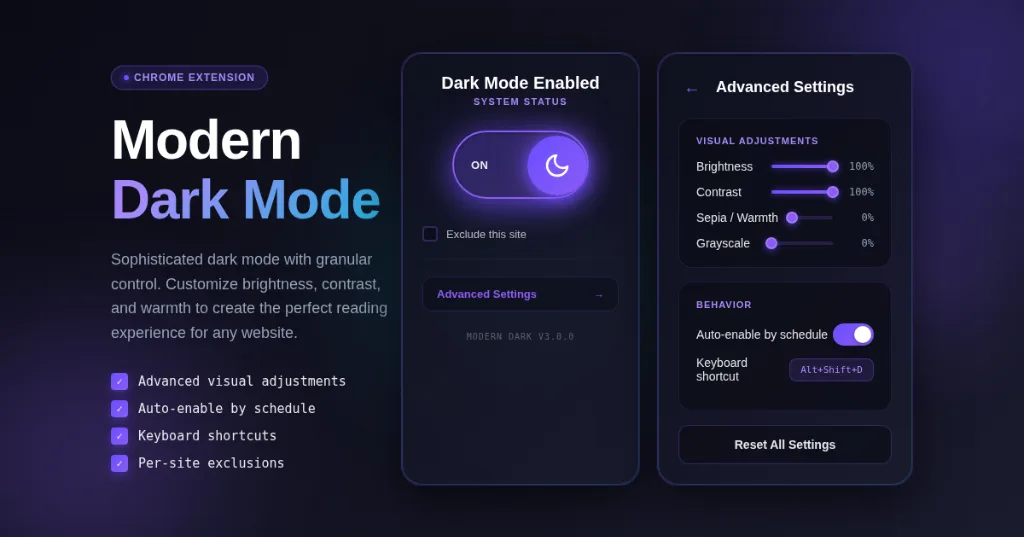
Smart CSS-filter-based dark mode for any site, with image color preservation via MutationObserver. Listed here because almost every "dark mode extension" on the Web Store either inverts images (ugly) or injects a 2MB CSS dictionary (slow). Modern Dark Mode does neither and stays under 50KB. Permissions: activeTab, storage. MV3: native.
Developer & Creator (3)
10. Builder.io DevTools
Visual editing of any site's DOM with AI-assisted refactor. You select a component, describe the change in plain English, and it generates a patch. Cutting-edge because the diffs are framework-aware — it understands React, Vue, and Svelte component boundaries. Permissions: activeTab, scripting, storage. MV3: native.
11. TestMu AI Screenshot
One-click screenshots of your current page across 25+ browser/OS combinations. Replaces a virtual machine farm. Cutting-edge because the visual-diff comparison uses an SSIM model rather than pixel diffing, so anti-aliasing doesn't trigger false positives. Permissions: activeTab, storage. MV3: native.
12. Qodo Merge (formerly CodiumAI PR-Agent)
AI code review inside GitHub PRs. Detects logic bugs, security issues, and convention violations before a human looks at the diff. The reason it earns a slot over generic Copilot-style tools: Qodo Merge runs as a reviewer, not an author — it doesn't write code, it audits it. That's a different and more valuable signal. Permissions: activeTab, host_permissions on github.com. MV3: native.
The 5 Categories I'd Skip in 2026
Lists never tell you what not to install. Here are the categories that look attractive but fail at least one of my three criteria:
- "All-in-one" AI sidebar wrappers that bundle GPT, Claude, and Gemini behind one paywall. They almost always require
- Free VPN extensions. The economics don't work. If you're not paying, your traffic is the product.
AI Consulting
Want AI Results, Not Hype?
Get practical AI strategy and implementation support for your business.
Explore AI ConsultingRecommended Extension
Modern Dark Mode
Modern Dark Mode is a free Chrome extension that adds dark mode to any website using intelligent CSS filter inversion. Preserves images and ...
Open in Chrome Web Store- "Dark mode" extensions that ship a 2MB CSS dictionary of per-site overrides. They feel comprehensive until you check the bundle size and notice your tabs eating 80MB of RAM each.
- Bookmark/tab managers with cloud sync but no zero-knowledge encryption. Your reading list is a goldmine of private data. If the vendor can read it, assume they will.
- Screenshot extensions that "save to cloud." Same problem. You can take screenshots locally with Ctrl+Shift+S and a clipboard manager.
The Permission Audit Table
| Extension | host_permissions | Risky APIs | MV3 | On-device AI |
|-----------|------------------|------------|-----|-------------|
| Claude for Chrome | user-approved per-site | scripting, tabs | ✅ | partial |
| Perplexity | none | activeTab | ✅ | ❌ |
| Gemini in Chrome | (built-in) | (browser-native) | n/a | ✅ |
| uBlock Origin Lite | none (DNR-based) | declarativeNetRequest | ✅ | ❌ |
| Bitwarden | clipboardRead/Write | ✅ | ❌ |
| Ghost Browser | none | storage only | ✅ | ❌ |
| Bardeen | scripting | ✅ | ❌ |
| Tactiq | none | tabCapture | ✅ | ✅ (opt-in) |
| Modern Dark Mode | none | activeTab only | ✅ | ❌ |
| Builder.io DevTools | none | scripting | ✅ | ❌ |
| TestMu AI | none | activeTab | ✅ | ❌ |
| Qodo Merge | github.com only | activeTab | ✅ | ❌ |
If you're permission-conscious, the bottom-third of that table (Modern Dark Mode, Ghost Browser, Qodo Merge, TestMu) is the safest install set.
What "Cutting-Edge" Actually Means in 2026
Three things, ranked:
1. On-device inference, so your data doesn't leave the machine
2. Agentic action, not just answer generation — the extension does something on your behalf
3. Declarative permissioning, where the extension asks for narrow, specific access rather than
An extension that hits at least two of those is genuinely 2026-class. One that hits zero is a 2019 idea wearing a new logo.
Frequently Asked Questions
Q: Is Manifest V3 still a real concern in 2026?
A: For new installs, no — the Web Store rejects MV2. For old extensions you've had installed since 2022, check the manifest. If you see "manifest_version": 2, the extension is no longer receiving updates and you should replace it.
Q: Are AI extensions safe to install?
A: Most are not, by default. Check whether the extension streams page content to a proxy server controlled by the extension vendor, or directly to the model API with your own key. The latter is much safer. Tactiq and Gemini in Chrome are exceptions — they support on-device modes.
Q: How many extensions is too many?
A: I run 18, but I'm a developer and most are off by default. For everyday use, keep 5-7 active. Each enabled extension adds startup time and memory overhead. Use Chrome's built-in chrome://extensions page to disable rather than uninstall — flip them on when you need them.
Q: What's the most overrated cutting-edge category?
A: AI sidebar wrappers. They're 2024 technology in 2026 packaging. The interesting work is in agentic browsing (Claude for Chrome) and on-device inference (Gemini Nano), not in giving you another way to chat with GPT-4.
Want to Keep Going?
If you're interested in the privacy-first half of this list, I wrote a deeper dive on the Top 10 Privacy-Focused Chrome Extensions in 2026. For the dev/creator picks, see the Ultimate List of Free Chrome Extensions for Developers. And if you want the broader landscape view, How AI Is Transforming Browser Extensions in 2026 covers the on-device + agentic shift in depth.
You can also browse my own extensions — I build privacy-first tools, all MV3-native, all open about what permissions they request and why.
Patrick Bushe is a digital product designer and Chrome extension developer based in Los Angeles. He has shipped 10+ extensions on the Chrome Web Store including Modern Dark Mode, AutoBrowser, and Ghost Browser. Find him at bushe.co.