Is Dark Reader Safe in 2026? Permissions, Privacy, and Alternatives
April 24, 2026 · 9 min read
Dark Reader is one of the most popular browser extensions on the planet, with tens of millions of installs across Chrome, Firefox, Edge, and Safari. Its Chrome listing requires Read and change all your data on all websites you visit, which is a permission level that gives any extension developer full visibility into your browsing. This is a fair concern. This guide answers the safety question honestly: what Dark Reader actually does with that access, what alternatives exist with smaller permission footprints, and how to evaluate any dark mode extension on the same criteria.
The Short Answer
Dark Reader is open source, has been audited by the community for over a decade, and has no documented history of malicious behavior or data exfiltration. The broad permissions it requests are technically necessary for what it does (rewriting page styles in real time across every site). It is reasonable to consider Dark Reader safe in the sense of not actively spying on you. It is also reasonable to consider any extension with all-sites permissions a concentrated risk if the maintainer ever changes hands or the codebase is compromised. Both of these things are true.
What Permissions Dark Reader Requests
On Chrome, Dark Reader requests:
1. Read and change all your data on the websites you visit. This is the active tab plus host permissions for all URLs. Required to inject CSS that overrides page styling.
2. Read your browsing history. Used to remember which sites you have toggled dark mode for.
3. Modify data you copy and paste. Used to clean up styling artifacts when copying from a darkened page.
These permissions sound alarming individually. They are also genuinely required for the feature set Dark Reader ships. A dark mode extension that does not have access to page contents cannot read or modify the styles it needs to invert.
What Dark Reader Does With Access
Dark Reader is open source on GitHub. The code is audited regularly by community contributors, and security researchers have looked at it because of its install base. As of 2026, no malicious behavior has been documented. The extension processes pages locally, does not phone home with browsing data, and does not send your URLs to a server.
An opt-in feature called Cloud Sync syncs your dark mode settings between devices through Dark Reader's servers. This is opt-in and disabled by default. If you do not enable it, no data leaves your browser.
Dark Reader does fetch a periodic update of fix lists for sites where automatic dark mode breaks. This fetch contains no identifying information about your usage; it is a standard update check.
Is Dark Reader Safe to Install
For most users, yes. The risks are:
1. Concentrated privilege. Like any extension with all-sites access, if Dark Reader's update channel were compromised, an attacker could push a malicious update to millions of users. This is a structural risk of the extension model, not specific to Dark Reader.
2. Maintainer change. The current maintainer is responsive and security-conscious. If the project changes hands, the new maintainer might have different priorities. This is true of every open-source extension.
3. Browser-specific differences. The Firefox version is published by the same maintainer. The Safari version is a separate paid app, also from the same maintainer. The Edge version is sourced from the Chrome Web Store. All current.
Is Dark Reader Safe for Work or Sensitive Browsing
AI Consulting
Need Help Implementing AI?
Get a practical AI roadmap, implementation support, and automation strategy tailored to your business.
Explore AI ConsultingRecommended Extension
Modern Dark Mode
Modern Dark Mode is a free Chrome extension that adds dark mode to any website using intelligent CSS filter inversion. Preserves images and ...
Open in Chrome Web StoreFor enterprise environments, the calculation is different. IT teams should evaluate any extension with all-sites permissions against their data policies. Many enterprises whitelist a small set of approved extensions and block the rest. If your work involves sensitive data (banking, health, legal), the conservative position is to either not install a dark mode extension or to use one that is locally-only with no opt-in cloud features.
Dark Reader's Cloud Sync is opt-in, but the broad permissions remain regardless. If your security policy treats permissions as the threat model rather than active behavior, no dark mode extension fully passes.
Alternatives With Smaller Permission Footprints
A few alternatives offer different trade-offs:
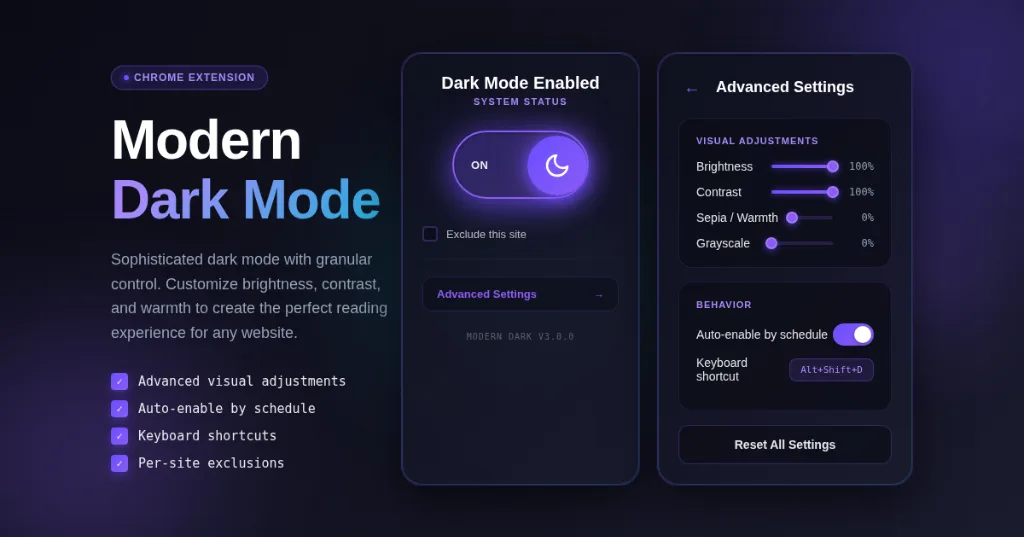
1. Modern Dark Mode requests the same broad permissions because, again, dark mode requires page access. The difference is granular control: 25 toggles for what to change, so users can dial back what gets touched on each site. Open source review available, no Cloud Sync, no third-party servers.
2. Night Eye uses ML-based color inversion. Same permission requirement. Paid product with a more curated update model.
3. Browser-native dark mode (Chrome flags Force Dark, Edge auto dark mode for web contents). No extension required; the browser itself does the inversion. The trade-off is that it works less well on complex sites (see our Chrome flags force dark guide).
4. Per-site userstyles via Stylus. Requires page permissions but only on sites you explicitly write rules for. More work but smaller footprint.
5. Reader mode in Safari and Chrome. Built-in, no extension. Only works on article-style pages.
The blunt fact is that any extension that visually transforms web pages needs page access. The choice is which extension you trust with that access, not whether the access is needed.
Dark Reader Free vs Paid
Dark Reader is free and open source on Chrome, Firefox, and Edge. The Safari version is paid because Safari does not support free distribution of extensions of this type through the App Store the same way. Dark Reader Pro and Dark Reader Premium are separate paid tiers offering filters and additional themes; the core dark mode feature is free.
Is Dark Reader Safe on Android
Dark Reader for Android is published by the same maintainer and uses the same codebase. The same permission and trust analysis applies. Android browsers that support extensions (Firefox, Kiwi, Yandex) can install Dark Reader directly. Chrome on Android does not support extensions at all, so Dark Reader is not available there. For Chrome Android dark mode, see our Android dark mode guide.
Is Dark Reader Safe on iPhone
Dark Reader for Safari iOS is the paid app version. Apple's App Store review process applies to it, which provides an additional layer of trust beyond browser extension review. The same maintainer ships it; the codebase is largely the same.
Key Takeaways
Dark Reader is open source, has a strong track record, and is reasonable to install for most users. The permissions it requests are necessary for any dark mode extension and are not Dark Reader-specific. The concentrated-trust risk applies to every all-sites extension and is the right thing to think about, not the wrong thing. For users who want a smaller permission footprint or more granular control, alternatives like Modern Dark Mode and Stylus userstyles exist. For browser-native dark mode without any extension, see our Chrome flags force dark guide. The cleanest path for most people is to install a trusted dark mode extension, opt out of any cloud-sync features, and review your installed extensions periodically.