Safari Dark Mode: How to Enable It on iPhone, iPad, and Mac (2026)
Patrick Bushe
April 24, 2026 · 5 min read
Safari has supported dark mode since Safari 12 on Mac and iOS 13 on iPhone and iPad. The Safari interface follows your system theme automatically. Websites are a different story: some publish a dark stylesheet, most do not. This guide covers every path to a consistently dark Safari, on every Apple device.
The Short Answer
Safari follows the system dark setting for its own UI. To make websites also render dark, the cleanest paths are: on Mac, install a Safari extension like Modern Dark Mode that handles per-site dark mode with image preservation; on iPhone and iPad, install a content blocker that supports custom CSS or has a built-in force-dark feature. For users who only need a few specific sites darkened, Safari's Reader mode is a free fallback.
Enable Safari Dark Mode on Mac
The Safari UI follows your Mac system theme.
1. Click the Apple menu, then System Settings (or System Preferences on older macOS).
2. Click Appearance.
3. Choose Dark or Auto.
Safari toolbars, sidebars, and the start page are now dark. Websites that publish a prefers-color-scheme: dark stylesheet automatically render dark too.
For websites that stay white, install a Safari extension built for the job:
1. Open the Mac App Store.
2. Search for a dark mode Safari extension. Modern Dark Mode, Night Eye for Safari, and Noir are the main options.
3. Install and follow the setup prompt.
4. Open Safari, click Safari in the menu bar, Settings, Extensions.
5. Enable the extension.
6. Visit any website. It should now render dark.
For a side-by-side comparison of these extensions, see our Dark Reader vs Modern Dark Mode review, which covers Mac Safari support.
Enable Safari Dark Mode on iPhone
Safari iOS follows the iPhone system theme.
1. Open Settings.
2. Tap Display and Brightness.
3. Tap Dark.
Safari toolbars and the start page go dark. Websites with native dark support follow.
For websites that stay white, iOS Safari does not support traditional extensions. The path is content blockers with custom CSS rules.
1. Open the App Store.
2. Search for a Safari content blocker that supports dark mode. AdGuard for Safari, Wipr 2, and 1Blocker all have force-dark or custom-style features.
3. Install and open the app once to configure.
4. Open Settings on iPhone, Safari, Extensions.
5. Toggle on the content blocker.
6. Open Safari, search for a website, confirm it loads dark.
If the content blocker does not have a built-in dark mode, look for a third-party userstyle list and import it.
For a deeper iPhone walkthrough, see our iPhone dark mode guide.
Enable Safari Dark Mode on iPad
Safari on iPad behaves like Safari on iPhone. The system theme controls the Safari UI. Content blockers handle websites.
1. Settings, Display and Brightness, Dark.
2. App Store, install a content blocker with dark mode support.
3. Settings, Safari, Extensions, enable.
AI Consulting
Need Help Implementing AI?
Get a practical AI roadmap, implementation support, and automation strategy tailored to your business.
Explore AI ConsultingRecommended Extension
Modern Dark Mode
Modern Dark Mode is a free Chrome extension that adds dark mode to any website using intelligent CSS filter inversion. Preserves images and ...
Open in Chrome Web StoreIn 2026, iPad has gained more extension flexibility through iPadOS, so some Safari extensions that work on Mac also work on iPad. Check each extension's listing for iPad support before installing.
Safari Dark Mode for All Websites (Force Dark)
The phrase safari ios dark mode all websites is one of the most common searches because Safari does not have a built-in force-dark for websites. The path is always a third-party tool: a content blocker on iOS or an extension on Mac.
Trade-offs:
1. Content blockers are simple but have less control. They use shipped rules; you cannot customize per-site easily.
2. Extensions on Mac are more powerful. They let you toggle per-site, customize brightness and contrast, and preserve images.
3. Reader Mode in Safari forces a clean, dark layout for any article-like page. Tap the AA icon in the address bar, then tap the moon. This works for blog posts and news articles. It does not work for app-like sites.
Use Reader Mode for Quick Dark Mode on a Single Page
Reader Mode is a built-in Safari feature that forces a clean, dark, distraction-free view of any article. To use:
1. Open a website in Safari.
2. On Mac, click the Show Reader View icon (a paragraph symbol) in the address bar.
3. On iPhone or iPad, tap the AA icon, then Show Reader.
4. Tap the moon icon to switch Reader Mode to dark.
Reader Mode strips ads, sidebars, and most styling. It is the closest thing Safari has to a built-in dark mode for websites. The downside is it only works on article-style pages and changes the layout, not just the colors.
Best Safari Dark Mode Extension
The best choice depends on your platform.
Mac: Modern Dark Mode for full per-site control with image preservation. Night Eye for ML-based color inversion. Noir for native macOS look. Each is paid or has a paid tier.
iOS and iPadOS: AdGuard for Safari is the most flexible content blocker with dark mode support. Wipr 2 is simpler. 1Blocker is more configurable.
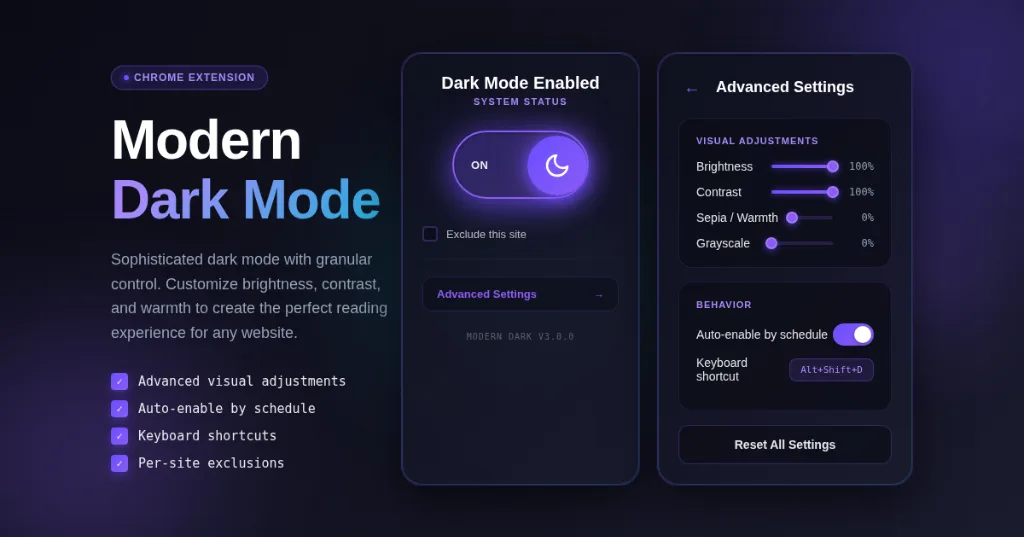
For users coming from Chrome's extension ecosystem, our Modern Dark Mode extension ships for Chrome and Chromium browsers with full per-site dark mode and 25 toggles for fine control. Mac Safari is on the roadmap.
Fix Dark Mode Not Working in Safari
If Safari is not respecting your system dark setting, three things to check.
1. The system itself is set to Light. System Settings, Appearance, Dark.
2. A specific website has its own light-mode override. Some sites have a sun or moon toggle in the header that overrides the system preference.
3. Reader Mode is set to light. AA icon, tap the sun to switch Reader to dark.
If Safari is supposed to be dark and it is showing a white URL bar, the issue is the system theme. Switch to Dark in System Settings.
Dark Mode for Google Sites in Safari
Google Search, Drive, Docs, and Sheets in Safari often ignore the system dark setting because they expect their own theme controls inside each Google app. To force dark on Google sites in Safari, you need a content blocker (iOS) or extension (Mac) that handles modern web apps. For Sheets specifically, see our Google Sheets dark mode guide, which covers the cell-color preservation problem.
Key Takeaways
Safari has good built-in dark mode for its own UI. For websites, the experience splits by device: Mac gets full extensions, iPhone and iPad rely on content blockers. Reader Mode is a free fallback for article pages. For deep customization, dedicated dark mode extensions are still the gold standard. Modern Dark Mode is built for this on Chromium browsers and is the closest equivalent to a power-user tool when it lands on Safari. Safari users also dealing with Google AI Overviews should see our Hide Google AI Overviews in Safari guide.