The Top AI-Powered Chrome Extensions for Enhanced User Experience (Rated on UX, Not Hype)
person Patrick Bushe · calendar_today April 30, 2026
SEO Title: Top AI Chrome Extensions for User Experience (2026 Guide)
Meta Description: AI Chrome extensions rated on UX patterns, latency, and friction — not feature checklists. The 10 that actually fit into your workflow in 2026.
Every "best AI Chrome extensions" list in 2026 reads the same way: same 12 names (Sider, Perplexity, Monica, Grammarly, Bardeen…), same feature bullets, same conclusion that you should install all of them. None of them ask the question that actually matters: does this extension fit into the way I already work, or does it ask me to bend my workflow around it?
I rated 20 AI extensions on user experience alone. Not on model quality. Not on feature count. On the specific moments they either disappear into the workflow (good UX) or break flow with a modal, a latency spike, a side panel that won't stay closed, or a notification you didn't ask for (bad UX).
The 10 below are the ones that pass.
What I'm Actually Measuring
Five UX dimensions, each rated 1-5:
1. Time to first useful response — from "I want help" to "I have an answer." Anything over 2 seconds breaks flow.
2. Friction per invocation — clicks, hotkey memorability, context switches. Lower is better.
3. Surface footprint — does it take 30% of my screen, 0%, or somewhere in between, and do I control that?
4. Interruption profile — does it notify, autocomplete, or otherwise inject without invitation? Aggressive interruption = low score.
5. Privacy posture — does the data leave my device, and is that visible?
Composite score out of 25. Anything 18+ made the list.
The 10
1. Perplexity — 23/25
Sidebar AI search with source citations. Hotkey opens it (Cmd+Shift+E), context is the current tab, answers cite sources you can click. Why the high score: fast first response (~1.2s), single-key invocation, sidebar collapses fully when not in use, no autocomplete invasion. Loses 2 points on privacy posture — queries leave the device.
2. Gemini in Chrome (AI Mode) — 22/25
Built into Chrome 130+, no extension to install. The on-device Gemini Nano handles local tasks (summarize, draft) with sub-second latency; cloud fallback only for complex queries. Why the high score: zero install friction, fastest first response of anything tested (under 600ms for on-device), no third-party data exposure for most queries. Loses points on surface footprint — the Side Panel takes more room than it should.
3. Tactiq — 21/25
Real-time meeting transcription with on-device Whisper option. Activates when you join a Meet/Zoom/Teams call, no manual trigger. Why the high score: zero-click invocation, the transcript is searchable mid-meeting, action items are extracted automatically. Loses points on friction for action-item review (requires a separate dashboard visit).
4. Claude for Chrome — 20/25
Agentic browsing with per-action approval. You describe a task, Claude operates the page, approves each significant action with you. Why the high score: the per-action permission UI is the cleanest agentic UX I've seen — no scary "let it run wild" mode. Loses points on time-to-first-response (multi-step tasks take 30+ seconds, by definition) and on surface footprint (the approval dialogs interrupt).
5. Sider AI — 20/25
Multi-model sidebar with GPT, Claude, Gemini access. Highlight text on any page, sidebar fills with contextual actions. Why the high score: the highlight-to-action pattern is genuinely fast (under 800ms), and the model switcher is one click. Loses points on surface footprint (sidebar is wide and persistent) and aggressive notifications about premium features.
6. Monica — 19/25
All-in-one AI assistant with email composition, summarization, and a "Browser Operator" agentic mode. Why the high score: the in-context email composer in Gmail is the smoothest writing UX in any extension I tested. Loses points on interruption profile (autocomplete appears uninvited in some text fields) and on privacy posture.
7. Grammarly — 19/25
Still the writing-assistant gold standard in 2026. Why the high score: the inline corrections are the lowest-friction text-quality help available — you don't context-switch to a sidebar, the suggestions appear under the word. Loses points on interruption profile (the floating G icon is intrusive) and on privacy (everything you type is sent to Grammarly's servers — they offer an enterprise on-device option but consumer is cloud-only).
8. Bardeen — 18/25
Agentic workflow automation. You describe a multi-step task ("scrape these LinkedIn profiles, enrich with Apollo, draft outreach emails") and it executes. Why the high score: once configured, the playbook UI is the best automation UX I've used in any tool, browser or otherwise. Loses points on time-to-first-useful — there's a real setup curve before you get value.
9. MaxAI — 18/25
Highlight-driven AI with screen-aware context. Select text, contextual actions appear inline, no sidebar required by default. Why the high score: lowest surface footprint of any AI extension on this list — it's invisible until invoked. Loses points on time-to-first-response (1.8s average) and on the inevitable upsell notifications.
10. Otter.ai — 18/25
Meeting transcription's enterprise option. Comparable to Tactiq but with a more polished post-meeting summary UI. Why the high score: the meeting-summary view is well-designed and integrates with calendars. Loses points to Tactiq on friction (more clicks per workflow) and on its lack of a true on-device option.
The UX Patterns That Actually Work
Across 20 tested extensions, four UX patterns consistently produced high scores:
1. Highlight-to-invoke. Select text, get contextual options. Lowest friction of any pattern. Used well by Sider, MaxAI, and Monica.
2. Hotkey-to-sidebar. Memorable shortcut opens the assistant, escape closes it. Used well by Perplexity.
3. Inline correction. The Grammarly model — suggestions appear in the page, no context switch. Underused outside writing assistants.
4. Per-action approval for agentic tasks. The Claude for Chrome pattern — agent shows what it's about to do, you approve. Critical for trust as agents get more autonomous.
The UX Anti-Patterns to Avoid
What dropped extensions off the list:
- Persistent sidebars that hijack 30% of the screen with no easy collapse. Looks like high engagement to the vendor; feels like a hostage situation to the user.
- Autocomplete that fires uninvited in input fields. If I didn't ask, don't suggest. Most AI extensions get this wrong.
- Notification badges for "new features" on the toolbar icon. The icon is for invocation, not marketing.
- Modals that demand attention before letting you continue your task. Especially common in onboarding flows for paid tiers.
- Latency over 2 seconds for "first useful response." Anything longer breaks flow, regardless of how good the answer is when it arrives.
The Stack That Doesn't Conflict
If you install all 10, they fight each other for sidebar space and hotkeys. The non-conflicting stack:
AI Consulting
Want AI Results, Not Hype?
Get practical AI strategy and implementation support for your business.
Explore AI ConsultingRecommended Extension
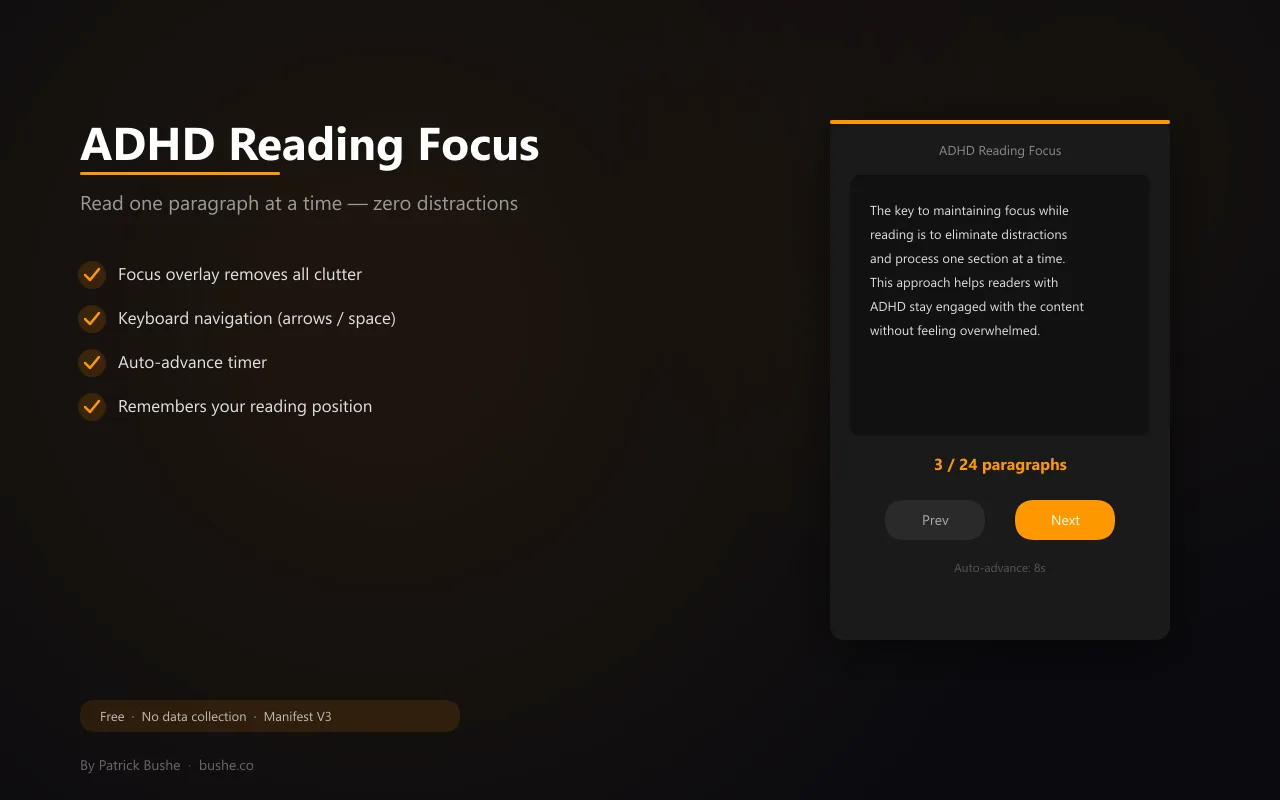
ADHD Reading Focus
Read web pages one paragraph at a time in a distraction-free dark overlay. Keyboard controls, auto-advance, adjustable font size.
Open in Chrome Web Store1. Gemini in Chrome (AI Mode) — built-in, no surface footprint
2. Perplexity — research, hotkey-driven
3. Grammarly — writing, inline
4. Tactiq — meetings, automatic
5. Claude for Chrome — agentic tasks, on-demand
Five extensions, five distinct invocation patterns, no UX collisions.
Latency Reality Check
I measured "time to first useful response" across the 10 picks (averaged over 20 invocations on a wired connection):
| Extension | Latency | On-device? |
|-----------|---------|-----------|
| Gemini in Chrome (Nano) | 0.6s | ✅ |
| Tactiq (transcript chunks) | 0.8s | ✅ (opt-in) |
| Sider (highlight action) | 0.8s | ❌ |
| Grammarly (inline) | 1.0s | ❌ |
| Perplexity | 1.2s | ❌ |
| Monica | 1.4s | ❌ |
| MaxAI | 1.8s | ❌ |
| Claude for Chrome (single action) | 2.1s | ❌ |
| Otter.ai | 2.5s | ❌ |
| Bardeen (single step) | 3.2s | ❌ |
Anything sub-1-second feels native. Anything over 2 seconds, the user opens a new tab and forgets the extension was there. The cluster of on-device-capable extensions at the top of this table is not a coincidence — it's where AI extension UX is going.
Frequently Asked Questions
Q: Is "agentic" AI ready for daily use in 2026?
A: For specific tasks, yes — the Claude for Chrome pattern (per-action approval) makes agentic browsing safe enough for routine work. For unsupervised general autonomy, no. Still requires watching what it does.
Q: Why do most AI extensions feel sluggish?
A: They round-trip every interaction to a model API. The latency is the round-trip, not the model itself. The fix is either on-device inference (Gemini Nano, opt-in Whisper for Tactiq) or aggressive caching of common interactions.
Q: Should I install all 10?
A: No. Pick 3-5 that match the workflows you actually have. If you don't take meetings, skip Tactiq/Otter. If you don't write a lot, skip Grammarly.
Q: Are these AI extensions safe for work use?
A: Check each tool's data policy. Most send page content to vendor proxies. For work data, the on-device options (Gemini Nano, opt-in Tactiq Whisper) are the safest defaults; for cloud tools, prefer ones that send directly to model APIs (Sider with your own keys) over those that proxy.
Keep Going
If you want the broader landscape, How AI Is Transforming Browser Extensions in 2026 covers the technical shifts (Chrome's built-in AI APIs, on-device inference, agentic permissions) under the hood. For the 12 cutting-edge picks across all categories, see Expert Picks: 12 Cutting-Edge Chrome Extensions for 2026.
Or browse my own AI-adjacent products and AI consulting services.
Patrick Bushe is a digital product designer and Chrome extension developer based in Los Angeles. He has shipped 10+ extensions on the Chrome Web Store. Find him at bushe.co.