Windows 11 Dark Mode: System, Apps, Chrome, and Edge (2026)
April 24, 2026 · 8 min read
Windows 11 has had a polished dark mode since launch, but the rollout across apps and browsers is uneven. The system, File Explorer, and Microsoft Store all follow your theme. Office apps have their own preference. Chrome and Edge each have separate settings. This guide covers every layer in the order you will likely set them.
The Short Answer
Open Settings, Personalization, Colors, and switch Mode to Dark. That covers the system UI, taskbar, Start menu, File Explorer, and most modern Microsoft apps. For Chrome, Edge, Office, and other applications with their own theme controls, dark mode needs to be enabled separately inside each one.
Turn On Dark Mode in Windows 11
1. Right-click the desktop and choose Personalize, or open Settings, Personalization.
2. Click Colors.
3. Under Choose your mode, select Dark.
The system UI darkens immediately. Some elements (like the Start menu transparency tint) update right away; others may need a sign-out or restart for the new theme to fully apply.
If you only want app surfaces dark but the taskbar light (or vice versa), choose Custom and set Choose your default Windows mode and Choose your default app mode independently.
Turn On Dark Mode in Windows 10
1. Open Settings.
2. Click Personalization.
3. Click Colors.
4. Under Choose your color, pick Dark.
The Windows 10 path is similar to Windows 11. Both follow the same logic for app-level vs system-level overrides.
Make Chrome Dark Mode on Windows 11
Chrome on Windows follows the system theme by default, but it has its own override.
1. Open Chrome.
2. Click the three-dot menu, then Settings.
3. Click Appearance in the left sidebar.
4. Under Mode, pick Dark or Device.
If websites still load light even with Chrome dark, the websites do not have their own dark stylesheets. To force dark on them, either enable the Chrome flag at chrome://flags (see our Chrome flags force dark guide) or install a dark mode extension. The extension is the better choice for most users because it preserves images and offers per-site control.
Make Chrome Dark Mode on Windows 10
The path is identical to Windows 11. Three-dot menu, Settings, Appearance, Mode, Dark. Chrome detects the Windows version automatically and applies the dark theme accordingly.
Turn On Microsoft Edge Dark Mode
Edge has its own theme settings.
1. Open Edge.
2. Click the three-dot menu, then Settings.
3. Click Appearance.
4. Under Overall appearance, pick Dark.
Edge also supports forcing dark mode on websites:
1. Type edge://flags in the address bar.
2. Search Force Dark Mode.
3. Set Auto Dark Mode for Web Contents to Enabled.
4. Click Restart.
AI Consulting
Need Help Implementing AI?
Get a practical AI roadmap, implementation support, and automation strategy tailored to your business.
Explore AI ConsultingRecommended Extension
Modern Dark Mode
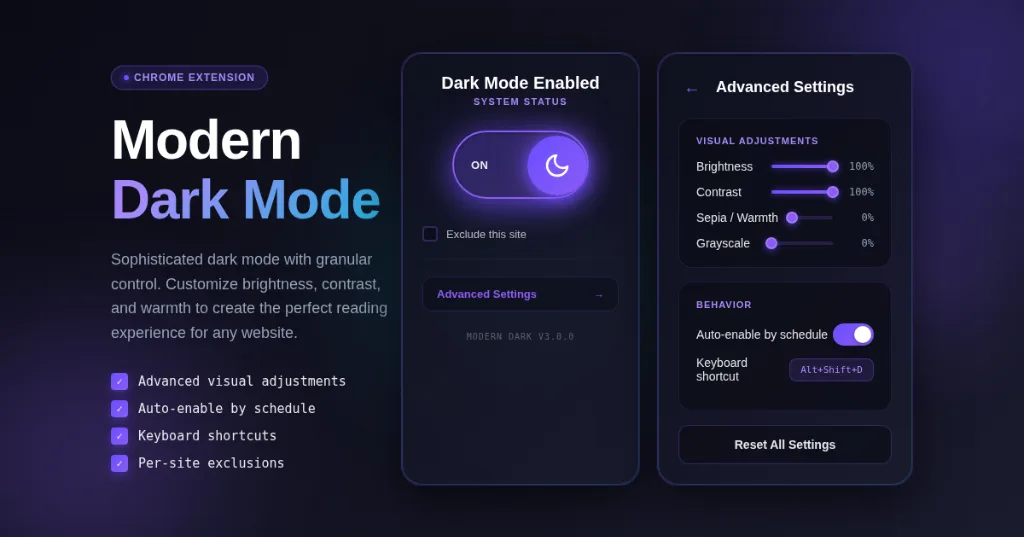
Modern Dark Mode is a free Chrome extension that adds dark mode to any website using intelligent CSS filter inversion. Preserves images and ...
Open in Chrome Web StoreOr use a dark mode extension from the Chrome Web Store, which works on Edge.
Microsoft Edge Dark Mode for All Websites
Edge does not have a built-in per-site dark mode. The options are the force-dark flag (global) or an extension (per-site control). For users who only want a few specific sites dark, an extension is the better fit.
Disable Dark Mode in Chrome on Windows 11
The reverse problem is also common. To switch Chrome from dark back to light:
1. Open Chrome.
2. Three-dot menu, Settings, Appearance.
3. Mode, pick Light.
If Chrome stays dark even after picking Light, the cause is usually a Chrome theme. Open Settings, Appearance, and click Reset to default under Theme. This removes any installed theme that locks the appearance.
Windows 11 Dark Mode Without Activation
A common search is windows 11 dark mode without activation. The good news: Windows 11 dark mode works whether or not your copy is activated. Personalization features in general are restricted on unactivated installs (you cannot change the wallpaper or accent color), but the dark mode toggle in Settings, Personalization, Colors is part of the basic UI and remains available.
If the Personalization page is grayed out on an unactivated install, you can still toggle dark mode through the Registry:
1. Press Windows+R, type regedit, press Enter.
2. Navigate to HKEY_CURRENT_USER\Software\Microsoft\Windows\CurrentVersion\Themes\Personalize.
3. Set AppsUseLightTheme to 0 and SystemUsesLightTheme to 0.
4. Sign out and sign back in.
The Registry path is a workaround. The Settings UI is the supported way once activation is complete.
Dark Mode Wallpaper for Windows 11
Dark mode does not change your wallpaper. To match the dark theme:
1. Right-click the desktop, Personalize, Background.
2. Choose a dark image, or pick Solid color and select black or near-black.
3. Optional: pick Slideshow with a folder of dark wallpapers and rotate them.
Windows 11 ships with a few dark theme bundles in Settings, Personalization, Themes. The Glow theme and Captured Motion theme include matching dark wallpapers.
Keyboard Shortcut to Toggle Dark Mode in Windows 11
Windows 11 does not have a built-in keyboard shortcut for dark mode. The closest options:
1. Use the Auto Dark Mode app (open source, Microsoft Store). It schedules and shortcut-binds dark mode toggling.
2. Create a PowerShell script that flips the AppsUseLightTheme registry value, then bind it to a hotkey through a tool like AutoHotkey or PowerToys.
For most users, the four-click path through Settings is enough.
Dark Mode Settings on Windows PC vs Mac
The Windows path is Settings, Personalization, Colors, Mode, Dark. Mac is System Settings, Appearance, Dark. Both work similarly: system UI follows the system theme, individual apps may override. The main difference is that macOS apps in 2026 are more uniformly dark-aware than Windows apps, where some legacy applications (especially older Win32 apps) still ignore the system setting entirely.
Key Takeaways
Windows 11 dark mode lives in Settings, Personalization, Colors. Chrome, Edge, and Office have their own dark mode settings inside each app. For websites that ignore your browser dark setting, an extension is the cleanest path. For users who want PC-wide dark mode with one toggle and a schedule, the Auto Dark Mode app from the Microsoft Store handles scheduling that Windows itself does not. For a deeper look at why browser flags break some sites, see our Chrome flags force dark guide. For Microsoft Word and Office users wanting to turn off Word's dark mode without changing the system theme, see our Word light mode guide. Before installing any extension with all-sites permissions, our Is Dark Reader Safe review covers what to check.