A farming idea by Patrick BusheIdea sketch · not a building plan
The Grazing Wheel
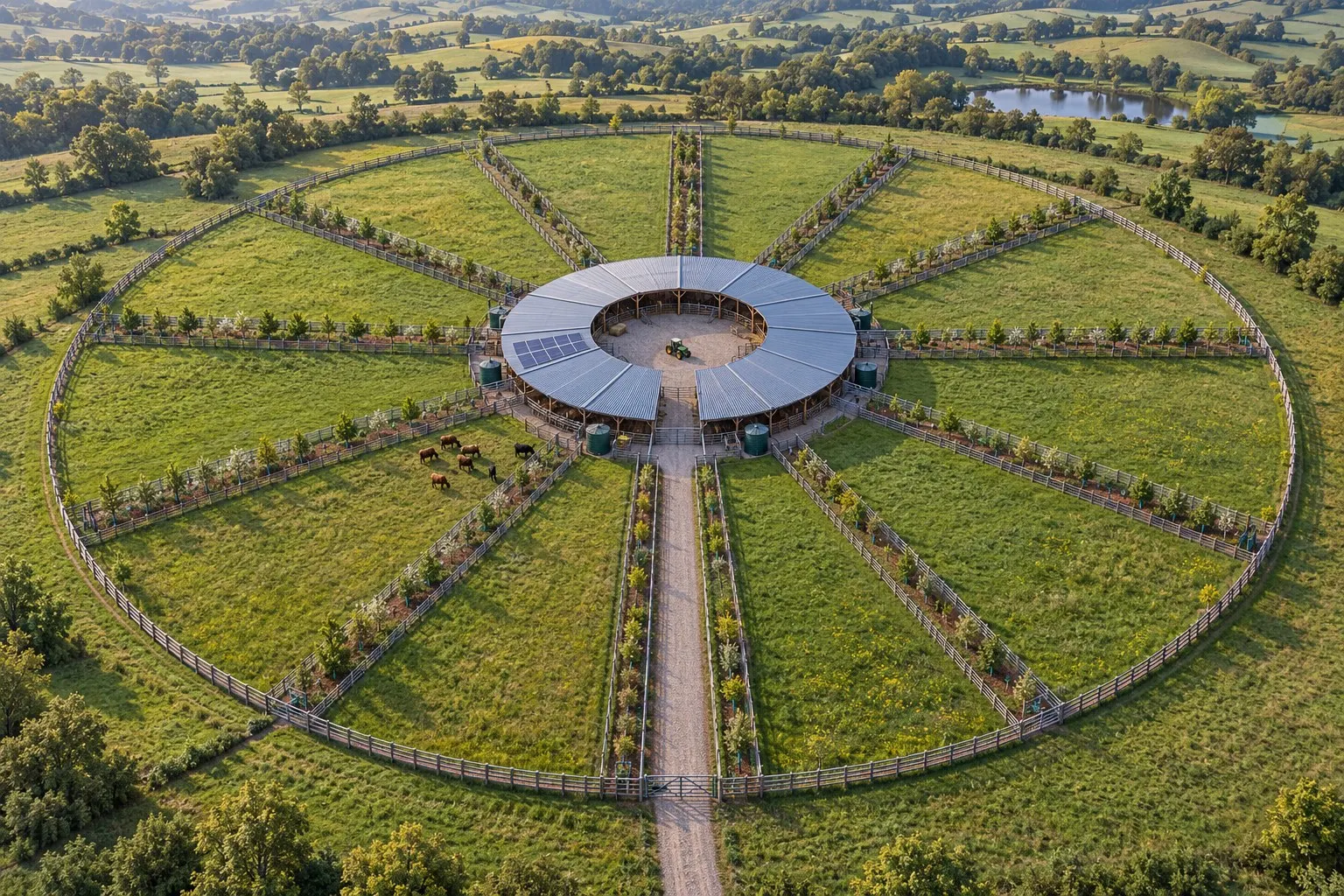
Twelve pastures cut like slices of a pie, with one round barn in the middle. The cows graze one slice at a time while the other eleven grow back.
In short
The idea in three lines
1 barn
in the middle. Hay, feed and shelter in one place, whichever slice the cows are in.
3–4 days
in each slice. Then shut that gate and open the next. Each slice gets about a month to grow back.
12 tree rows
between the slices. Shade in summer, a windbreak in winter, and some apples.
Will it work?
Yes, if you keep three things in mind:
Build one barn, not twelve. A barn in every slice would mean twelve times the roof, with eleven of them empty.
Your land sets the herd size. On average grass, 100 cows need about 430 acres. The calculator works it out for yours.
Apples are a snack. About 40 lb a day is the most a cow should eat.
marks a picture made on a computer to show the idea. Every other photo is a real farm, credited under it. The numbers come from university farm guides, listed at the bottom. Check them against your own land.
Part 1 · What it looks like
G‑1
The layout
Seen from above. Tap a slice to move the cows there.
Cut-through from the center to the grass · 100 cows · widths to scale
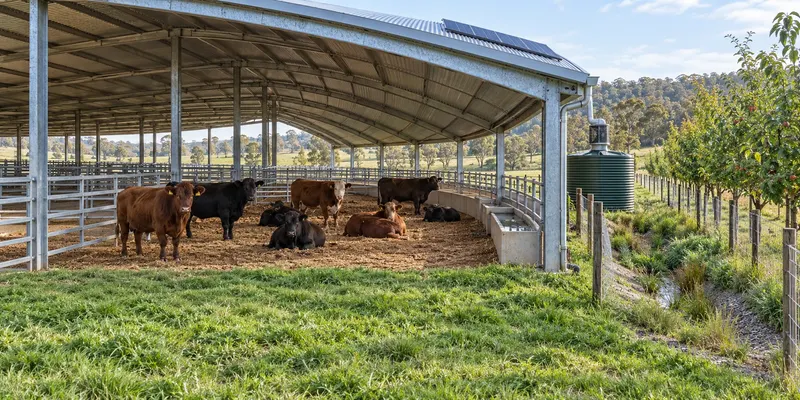
One slice of the round barn, cut open. Hay sits in the middle. The tractor drives the ring, fills the bunk, and never drives among the cows. The cows eat from the other side, rest on straw under the same roof, and walk out through the one open gate to graze. Shut that gate and open the next one, and the herd has moved.
100
cows in the example herd
10,000 ft²
of straw bedding at 100 ft² a cow
200 ft
of feed bunk at 2 ft a cow
1 roof
not 12: a barn in every slice would need 120,000 ft²
One barn, because the herd moves together
Wherever the cows sleep has to fit the whole herd. Put a barn in every slice and you build twelve of them, and eleven sit empty at any time. One round barn in the middle, with a gate into each slice, does the same job with one roof.
Farmers have built it before. The Shakers' Round Stone Barn in Hancock, Massachusetts (1826) kept hay in the middle and the cows in a ring facing in, so one person could feed the whole herd from the center. The Grazing Wheel adds the twelve pastures outside the wall. Sources: Hancock Shaker Village, round barns.
G‑3
The tree row, cut across
Between every two slices · not to scale
A row of fruit trees runs between every two slices. Two fences keep the cows off the trunks, and the branches reach over, so the cows get shade and a few apples. Under the trees, shallow level basins catch rain and the overflow from the barn tank, hold it until it soaks in, water the trees and top up the ground water.On a hill, half the tree rows run downhill. Dig the basins in short, level steps along the row, not as one long ditch. A ditch running downhill carries the water and the soil away. Level steps hold it where the roots are.
12
tree rows, one between every two slices
2
fences on each row keep the cows off the bark
27,000 gal
fall on an acre with each inch of rain
0
cherry, plum, peach or apricot trees by the fence
Pick the trees that are safe for cows
Apples and pears are fine in small amounts. Cherry, plum, peach and apricot trees are not: their wilting leaves are poisonous to cattle, so keep them away from the fence. The rain basins sit inside the fences, where hooves can't break them down. Survey the slope before you dig, so every basin is level.
Part 2 · Running it
G‑4
Move the herd, let the grass come back
Slide to see how long each pasture rests.
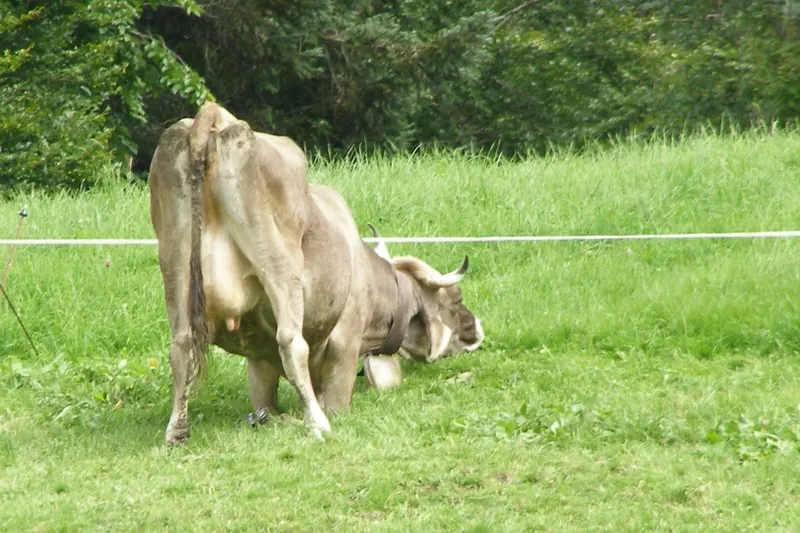
Every cow knows where the fresh grass is. Moving the herd every few days gives it to them on purpose.Photo: Erich Ferdinand from germany, Wikimedia Commons, CC BY 2.0
33 days
of rest before the herd comes back
36 days
to go all the way around
11
pastures resting at any time
OK
University of Maine: beef cattle 3 to 4 days, no more than 6 to 7
Rest is simple arithmetic: 11 × days in each pasture. The first idea was a month in each slice. That gives a long rest, but during a month the cattle keep coming back to bite the new shoots, which weakens the grass. Short stays work better, and the right rest changes with the season, as the next sheet shows.
G‑5
Where you are sets the numbers. The season sets the schedule.
How grass grows through the year, and what the wheel does in each season.
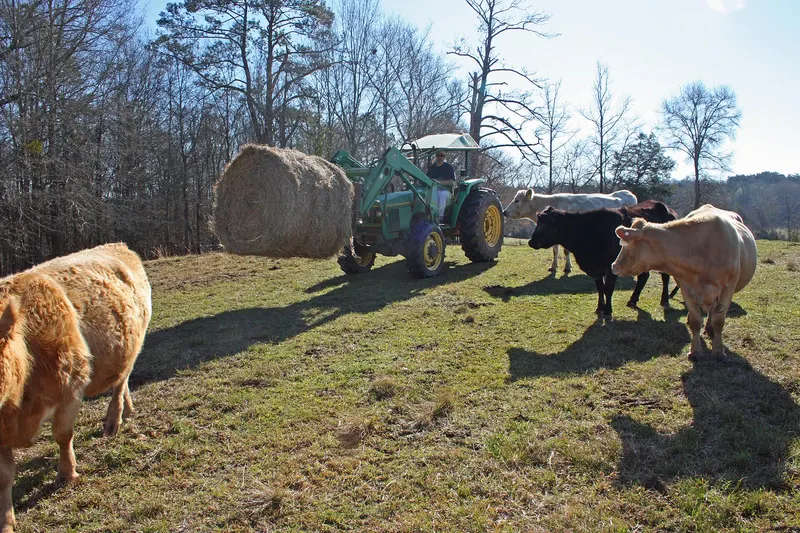
Winter in central Alabama: when the grass stops growing, hay comes to the cows. In the wheel it goes into the feed bunk.Photo: Alabama Extension, Wikimedia Commons, CC0
The shape of a typical cool-season pasture in the northern US, not measured data. Extension sources put roughly 40 to 60% of the year's growth in April to June. Warm-season grasses farther south peak in summer instead, and the schedule shifts with them.
Spring
About April to June
Grass
The flush. It grows faster than the herd can eat.
Rest between visits
About 18 to 25 days, or 10 to 14 in a cool, wet spring.
In the wheel
About 2 days per pasture (22 days of rest). Skip a few pastures and cut them for hay; the calculator says how many.
Summer
About July and August
Grass
Slows down. Regrowth can take a week or more just to start.
Rest between visits
About 30 to 50 days, and 40 to 60 when it's hot and dry.
In the wheel
3 to 4 days per pasture (33 to 44 days of rest). If the grass needs longer, feed hay in the barn rather than keep the herd in one place past 6 to 7 days. The roof earns its keep as shade.
Fall
About September to November
Grass
Picks up again for a while after the summer slump.
In the wheel
Leave a few pastures ungrazed late in summer so they can be grazed after growth stops (stockpiling).
Trees
Apples and pears drop; manage windfalls (G‑7). Storms bring down branches, so check for wilted leaves of risky trees.
Winter
When nothing grows
Grass
Dormant in the north. The herd lives on hay.
In the wheel
The herd stays in the barn and eats hay from the bunk. Studies put waste around 5% when hay is fed in a feeder or structure, against about 18% on average when it's fed on the ground.
Roof
Has to carry local snow and wind. Water lines need freeze protection, and manure builds up at the center.
Find your own numbers
Pasture yield:USDA Web Soil Survey lists pasture yields by soil, in animal-unit months (AUM) per acre. NRCS counts an AUM as about 780 lb of dry matter (26 lb a day for a month).
Grazing season, grass and rest days: your county extension office or NRCS service center.
Roof snow and wind loads: the ASCE Hazard Tool and your local building department.
Turn the wheel to the weather
A circle faces every direction, so it can be laid out for its own site. Put a thicker band of trees on the rim where the winter wind comes from: cattle start to need more feed below about 18°F, and in a University of Nebraska example a windbreak turns a −44°F wind chill into −15°F.
Put shade trees where the afternoon sun hits. From 70°F to 90°F, beef cattle drink 38% more water, and trees spread through the pasture shade them wherever they graze. G‑1 shows one example layout.
G‑6
Catch the roof. Keep the water clean.
Three separate water paths.
Gutters on the barn roof run to a covered tank. What the tank can't hold goes to the rain basins in the tree rows.
01 · Roof water
Roof → screen → first flush → covered tank
Gutters collect rain before it touches the cattle areas. Screen out debris, send the first dirty wash away, then store it in covered, dark, mosquito-proof tanks. Drip-water the orchard from the tank. Using it as drinking water for cattle needs suitable roofing, testing, treatment and a backup supply.
02 · Landscape water
Clean overflow → spreader → planted basin
Send extra tank water through protected outlets into the tree strips' basins, with safe spillways and a storm bypass. Slow it, spread it, let the soil take it in, and keep tree roots out of standing water.
03 · Cattle-area water
Dirty runoff → separate collection → treatment
Runoff from lanes, feed aprons and compost pads never goes into the clean tank or onto the orchard. Grade and curb so clean rain stays out of dirty areas. Scrape manure into a contained compost or storage area.
How much can the roof catch?
Gallons = roof ft² × inches of rain ÷ 12 × 7.48 × efficiency (each inch on each square foot is about 0.62 gallons). That's what the roof catches, not tank size or safe drinking water. Tank size follows the longest dry spell, not the yearly total. See NRCS roof runoff guidance and keeping clean and dirty runoff apart.
Part 3 · Extra feed and helpers
G‑7
Fruit from the trees is feed, but only a little
What falls into the pens, how much it can count for, and what to keep out.
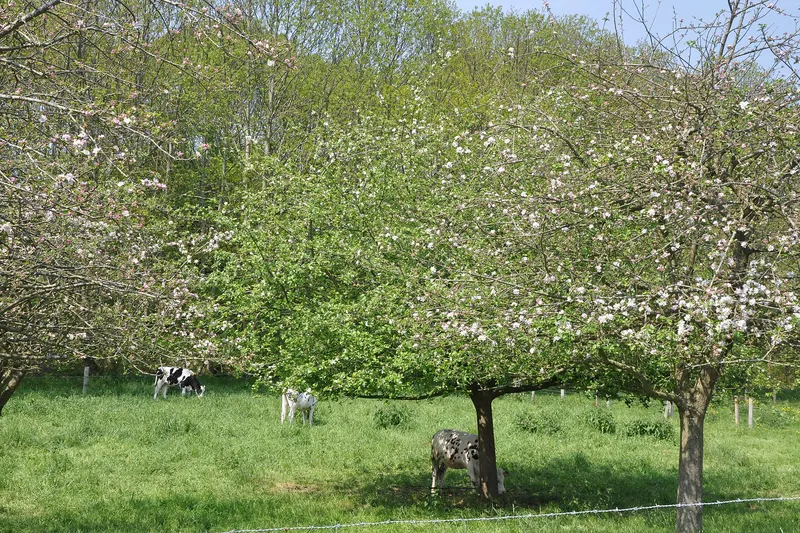
Cows grazing under apple trees in Le Tilleul, France. Fallen apples are a snack, not a meal.Photo: Philippe Alès, Wikimedia Commons, CC BY-SA 3.0
30 lb
dry matter a 1,200 lb cow eats a day (2.5% of body weight)
6 lb
most of that which should come from fruit-type feeds (0.5% of body weight)
≈42 lb
fresh apples to make 6 lb of dry matter, since apples are about 86% water
20%
of the day's feed, at most, and only in the weeks fruit is falling
Fallen fruit tops up the grass and hay. It can't replace them: the University of Florida's guide to feeding cull produce to cattle suggests keeping feeds like this to about 0.5% of body weight a day, measured as dry matter. The calculator works out the cap for your herd. The rest of the year, the trees give shade, shelter from wind and a fruit crop to sell.
Risk 1 · Choking
Whole apples can lodge in the throat.
Apples are one of the firm foods the Merck Veterinary Manual names as common causes of choke in cattle, along with potatoes and beets. Windfalls in the pen carry the same risk as fruit tossed over the fence.
Risk 2 · Gorging
A heavy drop can make cattle sick.
Cattle that eat a lot of fallen apples at once can get acidosis and bloat. In one Irish case, two cows died after the herd got into an old orchard, and windfall apples were the suspected cause. In heavy-drop weeks, move the herd past that pasture or pick up the windfalls and feed them in measured amounts.
Risk 3 · The wrong trees
No cherries, plums, peaches or apricots over the fence.
They're all in the Prunus family. When their leaves wilt, after a storm breaks a branch, they release cyanide, and cattle are especially at risk: 1.2 to 4.8 lb of wilted black cherry leaves can kill a 1,200 lb cow. Penn State and Purdue also flag red maple (wilted leaves), black locust, buckeye, red oak and yew.
Risk 4 · Sprays
Check the label before the herd goes back.
Some orchard sprays limit grazing for a set time after they're applied. Trees that drop fruit into a pasture are, in effect, part of the pasture, so spray choices and timing have to work for both.
A way to use the wheel for this: plan the rotation around the fruit. Graze the pastures beside a strip just before the main drop, keep the herd away while windfalls pile up, then collect them and feed them in measured amounts. Apples and pears with care, yes. Prunus, no.
JulAugSepOctNov
Early
Mid-season
Late
Mixed strips
Stagger the drop. If every tree ripens in the same few weeks, most of the windfalls are wasted or overeaten. Plant early, mid-season and late varieties, and give each tree strip a different mix, so the fruit comes down over more weeks and the herd stays closer to the cap. The months are an example; a local nursery knows your dates.
G‑8
Who else lives on the wheel
Permaculture gives every part more than one job. Three helpers, and how strong the evidence is for each.
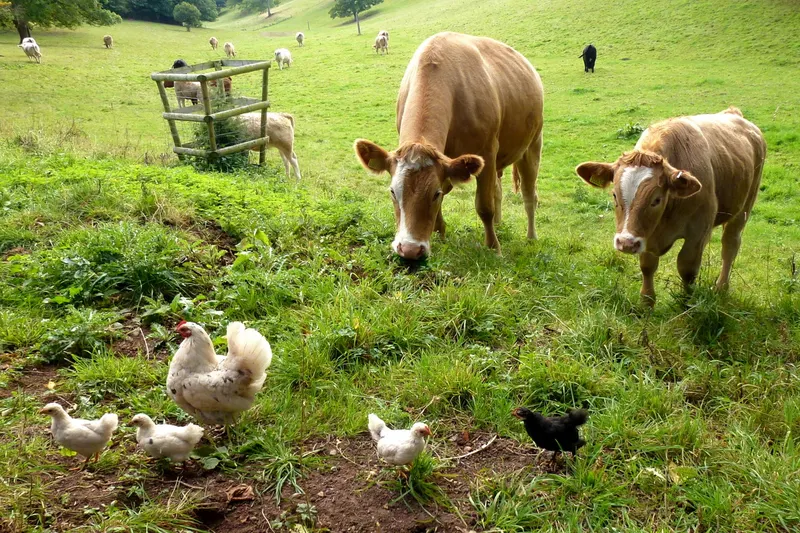
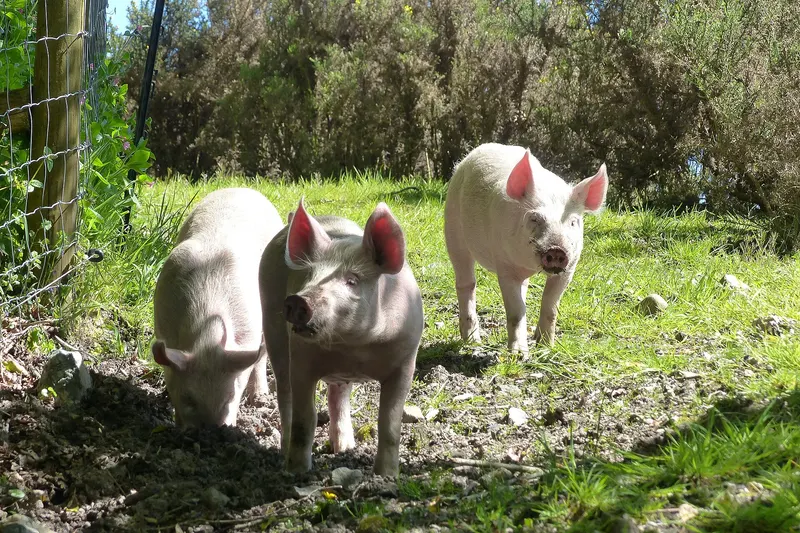
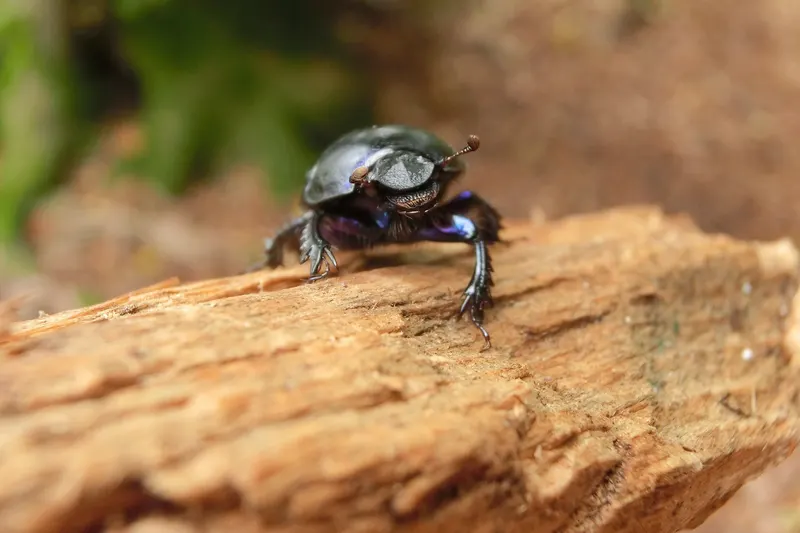
Hens and cattle sharing a pasture in Britain.Photo: Jonathan Billinger, Wikimedia Commons, CC BY-SA 2.0Pigs under trees. In the wheel they work the tree rows only.Photo: Ruth Sharville, Wikimedia Commons, CC BY-SA 2.0A dung beetle. It buries manure for free.Photo: Rohieb, Wikimedia Commons, CC0
Hens · one pasture behind the herd
The coop follows the cows.
A coop on wheels parks at the inner end of the pasture the cows just left, inside electric poultry netting, and moves when they move. With a few days per pasture, the hens always arrive about 3 to 4 days after the cows, and no one has to keep track.
What holds up: eggs from land the cows already use, and poultry manure, which is rich in nitrogen and phosphorus. What isn't proven: fly control. In a controlled trial, chickens left with manure pats for 3 to 4 days didn't lower face fly survival and mostly stayed away from the pats, and the University of Vermont found that flies follow the herd. Farms that run hens behind cattle say they see fewer flies, so count it as a maybe.
Watch for: foxes, hawks and dogs. The hens still need feed.
Holds upeggs, fertility Not provenflies
Dung beetles and clover
Keep the cleanup crew alive.
Dung beetles bury manure and break up pats for free. Ivermectin-type wormers pass into the manure and are very toxic to them, and pour-ons hit their larvae hardest. Pick a wormer with your vet that spares them, and treat only the animals that need it: overuse has already made worms resistant.
Clover feeds the grass. Mississippi State puts white clover at about 75 to 150 lb of nitrogen an acre a year. Keep it to 30 to 40% of the pasture, because above 50% legumes the risk of bloat goes up.
Holds upseveral studies and extension guides
Pigs · fruit drop only
Pigs clean up the early drop.
In a Michigan State pilot on an organic orchard, pigs ate the early fallen apples and the pest larvae inside them. Parts of the orchard without pigs had 3 to 5 times more plum curculio damage, and the larvae didn't survive a pig's gut. The researchers called it early data.
Pigs root up grass, so they belong in the tree strip only, behind netting, for a few weeks. They also need extra protein, since apples have very little.
Early dataone pilot
These follow two of the permaculture principles David Holmgren set out in 2002: integrate rather than segregate, so each animal does a job the others can't, and produce no waste, so manure, windfalls and pest larvae turn into feed or fertility. Every helper also adds work: fences, moves, feed and a vet plan.
G‑9
Make the rest of the farm work with it
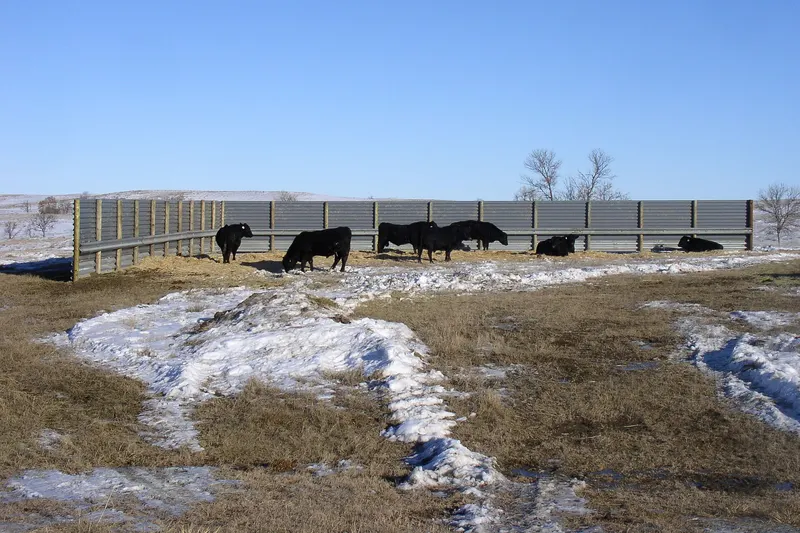
Cattle out of the wind behind a windbreak in South Dakota. A planted row of trees on the windy side does the same job.Photo: USDA NRCS South Dakota, Wikimedia Commons, Public domain
Soil and cover
Keep living roots and leave some grass behind.
Use grasses and legumes suited to the area, move the herd by how the grass is recovering, not the calendar, and keep a spot for holding cattle in wet weather.
Manure
Compost from the center to the trees.
Collect manure and bedding from the straw ring into a contained compost area, then spread the finished compost on the tree strips, where the herd doesn't graze right away. Ohio State puts bedded-pack manure at about 10 to 16 lb of nitrogen a ton, and it keeps more of it under a roof. Composting heat kills weed seeds. Soil and manure tests set how much goes where; keep raw manure away from fruit near harvest.
Energy
Use the roof twice.
Solar panels on the roof can run a small water pump, controls and electric fencing. Use float valves, leak alarms and a backup water source. Panels add load, so the structure has to be checked for them.
Habitat
Plant the edges for more than fruit.
Add native flowering ground cover and windbreaks where the weather calls for them, protect young trees, and keep habitat strips outside the cattle's reach. Trees do shade out some grass, so they cost some pasture.
Benefits depend on the site and the management. Nothing here assumes the farm is carbon neutral, self-sufficient in water or more productive. Manure management reference.
Part 4 · Size and limits
G‑10
Sized for 100 cows
Top view · the farm and the barn each to scale · example numbers
The whole farm for 100 cows, from above. The barn is the small dot in the middle: 160 ft across, on a circle about 4,900 ft across. Almost all the land is grass. Twelve slices of about 31 acres, a row of trees between every two, and the herd in one of them.
At the example numbers: 1,200 lb cows eating 2.5% of their weight a day, average grass that grows 4,000 lb an acre a year, half of it eaten, grazing April to November and hay the rest of the year. Better grass or a longer season needs less land.
G‑11
Start with the herd and the place. Then draw the circle.
Example numbers for adult beef cows. Change any of them.
These are planning sketches, not a stocking rate. A yearly total doesn't prove there's enough grass in a dry summer or that the grass gets enough rest. A grazing planner works that out month by month. Clover at 30 to 40% of the pasture (G‑8) adds nitrogen; enter the growth your own grass and clover mix gives.
The formulas
Herd dry matter a day = cows × weight × intake. Pasture needed = dry matter a day × days on pasture ÷ (growth per acre × share eaten). Hay = dry matter a day × days off pasture ÷ (1 − waste).
Spring flush: if the land is sized for the grazing season, spring grows the spring share of it in about 91 days, so it outgrows the herd by (days on pasture × spring share ÷ 91). The pastures to skip are the ones the herd can't keep up with.
Fruit cap = cows × weight × 0.5%, as dry matter, shown as fresh apples at 14.4% dry matter.
Barn: one shared straw ring of cows × bedded space. To let every cow eat at once along the inner arc, 75% of the arc is trough (the rest is gates). Trough radius r = the larger of 35 ft and trough length ÷ (2π × 0.75). A 14 ft feed apron is added to the bedded area. Roof outer radius R = √[(r + 14)² + bedded area ÷ π]. A 12 ft feed lane for the tractor sits inside the troughs. One roof covers all of it, hay included: roof area = πR². The minimum radius and the apron and ring widths are sketch allowances, not engineering standards.
Land = pasture ÷ 0.85 + the roofed center. The 15% covers tree strips and the road. The site diameter assumes a perfect circle of usable land. The plan drawing and the 100-cow picture don't resize to these results.
G‑12
What the drawing still has to solve
01 · Capacity
The land sets the herd size.
Acreage, grass growth, cattle weight and the season decide how many animals the land feeds. Subtract the center, the road and the tree strips first. At the example numbers, 100 cows need about 430 acres (G‑10).
02 · The center
All the work in one place means all the wear in one place.
Drainage, manure removal and firm footing matter at every gate. Gates have to guide cattle without dead ends and never mix them with feed trucks; the road crossing needs a set order of operations.
03 · Water
Catch rain without making a ditch.
A strip running straight downhill can speed up erosion. Survey the contours, how fast the soil soaks up water and where storm overflow goes before digging anything.
04 · Structure
The roof is the big cost.
For 100 cows the round barn is one roof of about 20,000 ft² over the hay, the feed lane, the feeding strip and the straw. Have an engineer check it for snow, wind and any solar panels before you price it.
In one sentence
A wheel of twelve pastures can put feed, water and shelter in one place and rest the grass, as long as the land sets the herd size,the season sets the schedule, the fruit stays a small treat, and the roof covers the herd once instead of twelve times.
.jpg)

,_apple_orchard_with_grazing_cows.JPG)


.jpg)