Best Dark Mode Settings for Coding All Night Without Eye Fatigue
Patrick Bushe
January 8, 2026 · 5 min read
Not all dark modes are equal. The default settings on most dark mode extensions
are calibrated for casual browsing — not for staring at a screen for four hours
while debugging a recursive function at midnight.
Here's what actually matters for reducing eye fatigue during long coding
sessions, and how to dial in your setup.
The real cause of dark-mode eye fatigue
Counter-intuitively, dark mode can cause more eye strain than light mode if
configured poorly. The main culprits:
Excessive contrast: Pure black backgrounds (#000000) with pure white text
creates harsh contrast that causes a halation effect — the white text seems
to bleed into the black background, especially on OLED screens. This is worse
than reading black text on white because the human eye adapts to the ambient
light level.
Inconsistent brightness: When some browser tabs are dark and others are light,
your eyes constantly re-adapt. Every time you switch from a dark terminal
documentation tab to a light GitHub issue, your pupils adjust. Over four hours,
this constant cycling is exhausting.
Blue light in dark interfaces: Many dark themes are actually dark grey-blue,
which means you're still getting significant blue light emission even though
the background isn't white. Blue light isn't the catastrophic villain some
claims suggest, but it does affect melatonin and makes it harder to sleep
after a late session.
Optimal settings for coding sessions
Background: Use a dark grey rather than pure black. #1a1a1a to #2b2b2b is the
sweet spot — dark enough to reduce glare, not so dark that contrast is harsh.
Modern Dark Mode defaults to #212121 which is close to ideal.
Contrast: Target a contrast ratio of 4.5:1 to 7:1. Higher than 7:1 (like
pure black/white) causes eye strain. Lower than 4.5:1 is hard to read. In
Modern Dark Mode, the Balanced preset sits around 6:1 — use this.
Brightness: If you're coding after sunset, lower the extension's brightness
adjustment to 85-90% of normal. This dims code documentation and reference
pages you have open without affecting your editor. Pair this with your OS
night shift or night light to warm the color temperature.
Configuring Modern Dark Mode for a coding session
1. Set Theme to Balanced (not High Contrast — this is the counterintuitive
one. High contrast sounds like it would be better, but it's harder on eyes
over time.)
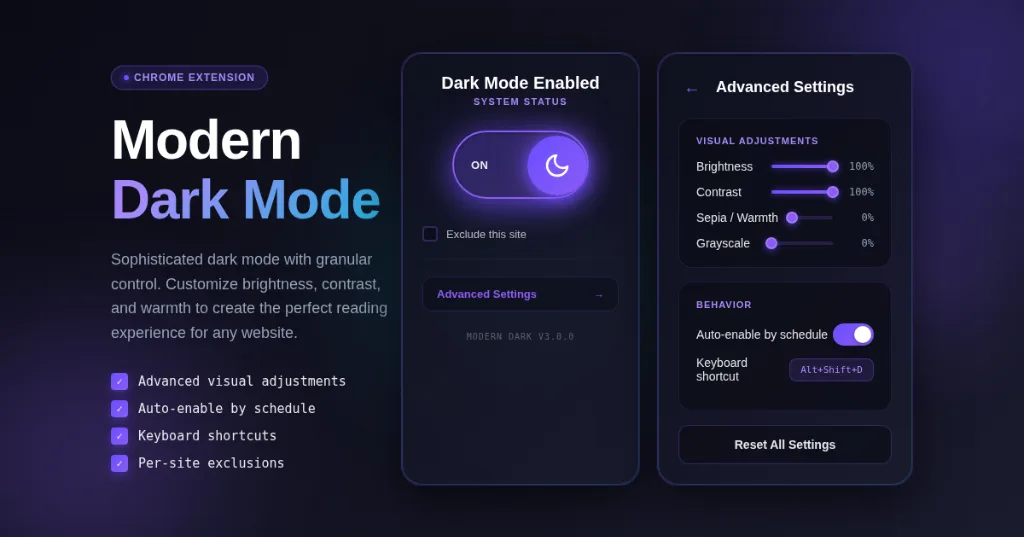
2. In the Brightness/Contrast sliders, set:
- Brightness: 92%
- Contrast: 95%
- Grayscale: 0% (keep colors, you need them for syntax highlighting in docs)
3. Enable Sepia tint at 10-15% — this warms the whites slightly, which reduces
the blue-tinged glare from documentation pages.
4. Add your editor documentation sites (developer.mozilla.org, docs.python.org,
devdocs.io) to Priority Sites so they get consistent rendering.
5. Add localhost and any internal tools to your dark mode rules so your local
dev server's UI is also dark during the session.
Beyond the extension: the full setup
The extension handles your browser, but a complete setup for night coding:
Editor: VS Code with a theme like Night Owl or Catppuccin Mocha — both
use carefully tuned contrast ratios rather than raw black/white.
OS level: Enable Night Light (Windows) or Night Shift (macOS) with a
color temperature around 3400K starting at sunset. This is separate from
dark mode — it warms all colors on your display.
Monitor hardware: Turn down backlight brightness. Most people have their
monitor at 100% brightness, which is designed for brightly lit offices.
At night, 40-60% is more comfortable. Your dark mode extension is working
against you if your backlight is still blasting at full power.
Breaks: The 20-20-20 rule — every 20 minutes, look at something 20 feet away
for 20 seconds. No extension fixes the mechanical fatigue from your eyes
holding a fixed focal distance.
A note on monitor type
The optimal dark mode settings differ depending on your display technology.
OLED monitors (and most modern laptop screens) produce true blacks — the
pixel is literally off. On OLED, a pure black background is genuinely dark,
but the contrast with white text is very high. The Balanced theme in Modern
Dark Mode uses #212121 (dark grey) instead of #000000 (black), which is
actually better for OLED because it reduces the extreme contrast ratio.
IPS and VA LCD monitors use a backlight that's always on behind the LCD
shutter. Even at their darkest, they can't produce true black — you'll
see some backlight bleed. For these monitors, a slightly darker background
(closer to #181818) works better because the backlight makes everything
look slightly lighter than the CSS value suggests.
Color temperature vs. brightness
Most people conflate these two settings but they're independent adjustments
that affect eye strain in different ways. Brightness affects how much total
light the monitor emits. Color temperature affects the ratio of warm to
cool wavelengths in that light.
At night, you want both reduced. Night Light (Windows) or Night Shift
(macOS) handles color temperature automatically. Your monitor's brightness
control handles the total output. Modern Dark Mode handles the in-browser
contrast ratio. All three are necessary for a complete low-fatigue setup.