Dark Mode for Google Docs Without Breaking Formatting
Patrick Bushe
January 8, 2026 · 5 min read
Google Docs doesn't have a native dark mode. When you force dark mode through
the browser or an extension, you almost always get one of two problems:
white text on a white background (invisible), or the entire document canvas
turns grey and your carefully formatted headings and callouts look like a mess.
This is one of the trickier dark mode scenarios to handle correctly because
Google Docs renders the document as a live canvas with complex CSS that
interacts badly with naive color inversion.
What goes wrong with basic dark mode in Docs
When a dark mode extension does a simple CSS inversion — flipping background
white to dark, and dark text to light — Google Docs fights back. Here's why:
Google Docs uses inline styles extensively. Text color is set directly on span
elements as style attributes. When a dark mode extension inverts colors
globally, those inline black color values stay black while the background
turns dark. Result: black text on a near-black background.
Highlights and colored text break in the opposite direction. Yellow highlights
get inverted to a muddy purple. Red text becomes cyan. If you're reviewing
a document with tracked changes (red/green markup), the colors become
meaningless.
The manual workaround: use Docs built-in page color
Google Docs has an option under File → Page Setup that lets you change the
page background color. Set it to a dark grey (#1e1e1e or #2d2d2d works well)
and your document body goes dark. You then need to select all text and change
it to a light color manually.
This is tedious and breaks if you share the document — the dark background and
white text go with it, which other collaborators probably don't want. It's also
a per-document setting, not a global one.
A second option: Chrome's forced dark mode
Go to chrome://flags/#enable-force-dark and set it to Enabled with selective
inversion of non-image elements. This is better than full inversion because
Chrome is smarter about which elements to flip.
For Google Docs specifically, this mode sometimes produces acceptable results —
but it still breaks color-specific formatting and makes the toolbar icons look
odd.
How Modern Dark Mode handles Google Docs
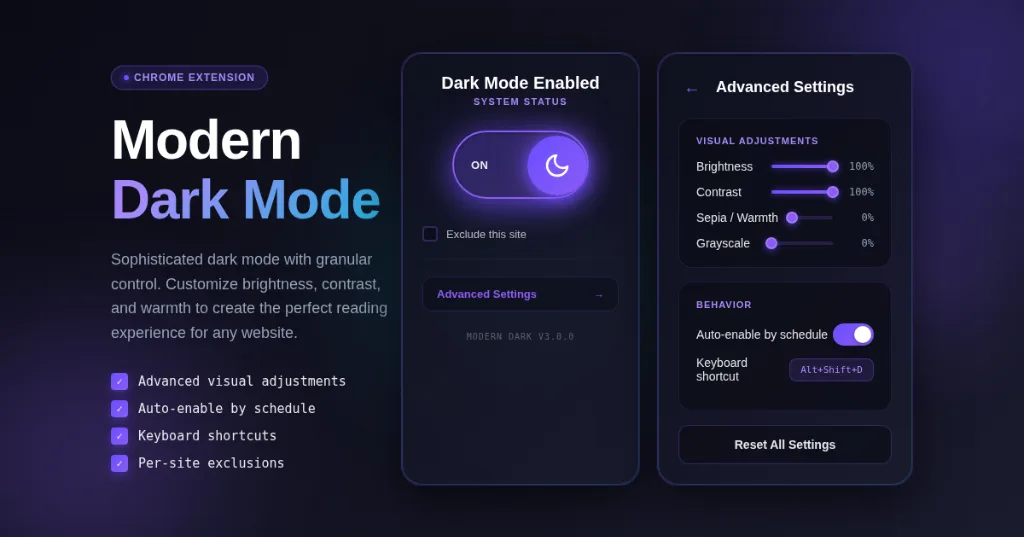
Modern Dark Mode has a specific Google Docs compatibility mode that uses a
different injection strategy for docs.google.com.
Instead of inverting CSS values, it applies a CSS filter to the outer chrome
(toolbar, sidebar, menu bar) and leaves the document canvas itself with a
neutral treatment. You get dark UI chrome around your document without the
canvas itself being color-inverted.
To enable this:
1. Open Modern Dark Mode settings
2. Go to Site-Specific Rules
3. Add docs.google.com with UI Only mode selected
4. Reload any open Docs tabs
With UI Only mode, the Docs toolbar, the sidebar panel, and the browser chrome
all go dark. The document page itself keeps its natural white background but
the surrounding interface is dark — which significantly reduces eye strain
during long editing sessions without breaking any of your formatting.
If you want a truly dark document canvas, the cleanest approach is actually
combining the extension with a Docs theme. In Docs, go to View → Document
Theme, create a new theme, and set the background to dark grey with white
body text. Save it as your default theme. Modern Dark Mode then handles the
UI chrome, and Docs' own theme system handles the document content.
A note on Google Sheets
Google Sheets has the same problem but worse — color-coded cells are the whole
point, and inversion destroys their meaning. Use the same approach: set Modern
Dark Mode to UI Only for sheets.google.com. The spreadsheet grid stays in its
natural colors and the interface around it goes dark.
Alternative: Google Workspace dark mode in 2026
Google has been slowly rolling out official dark mode support for Workspace
apps. As of early 2026, Google Docs has a beta dark mode under
Appearance Settings in your Google Account. If you're opted into the
beta, you can try it — the official implementation handles inline styles
correctly because Google's team can modify the app internals in ways an
extension can't.
The beta is inconsistent. It may not be available for all accounts, and
there have been reports of formatting issues in complex documents. But it's
worth checking before relying entirely on the extension approach.
To check: in Google Docs, open Settings (the gear icon) and look for
Theme or Appearance. If you see a dark option, it means the official
implementation has rolled out to your account.
For Docs on mobile
The desktop extension approach only applies to Chrome on desktop. On
Android, Google Docs supports system dark mode — enable dark mode at the
OS level and Docs will respect it. On iOS, the Google Docs app also
follows system appearance. Mobile dark mode in Docs handles inline styles
correctly because it's a native implementation, so the formatting issues
described above don't apply on mobile.