Why Dark Mode Hurts Your Eyes and How to Fix It
Patrick Bushe
March 4, 2026 · 5 min read
You switched to dark mode expecting relief from eye strain. Instead, your eyes feel worse. Text seems to blur, you squint more, and headaches come faster. You're not imagining it — many dark mode implementations actually increase eye strain instead of reducing it.
The Halation Effect
The most common issue with dark mode is called halation. When bright white text sits on a pure black background, the high contrast causes the white text to "bleed" or glow. Your pupils dilate to adjust to the dark background, then the bright text overstimulates parts of your retina. This creates a blurring effect that makes reading physically uncomfortable.
People with astigmatism — roughly 30% of the population — experience this more severely. For them, pure white on pure black can be genuinely harder to read than black on white.
Why Cheap Dark Mode Is Worse Than No Dark Mode
Simple dark mode implementations just swap white backgrounds to pure black and dark text to pure white. This maximizes contrast to levels that are actually harmful. Good dark mode design uses dark gray backgrounds instead of pure black and slightly muted text instead of pure white. The difference between a black background and a dark slate background seems subtle but has a major impact on comfort.
Most free dark mode extensions and browser-level forced dark mode don't consider this. They apply the highest possible contrast, which looks dramatic but fatigues your eyes faster.
What Proper Dark Mode Looks Like
The best dark mode implementations follow these principles. Backgrounds should be dark gray, not pure black. A value around RGB 30,30,30 to 40,40,40 reduces halation while still feeling dark. Text should be off-white, not pure white. Something around RGB 220,220,220 provides excellent readability without the glowing effect.
Accent colors should be desaturated. Bright neon colors that look fine on a white background become garish on dark backgrounds. Good dark mode reduces saturation by 10-20% to compensate.
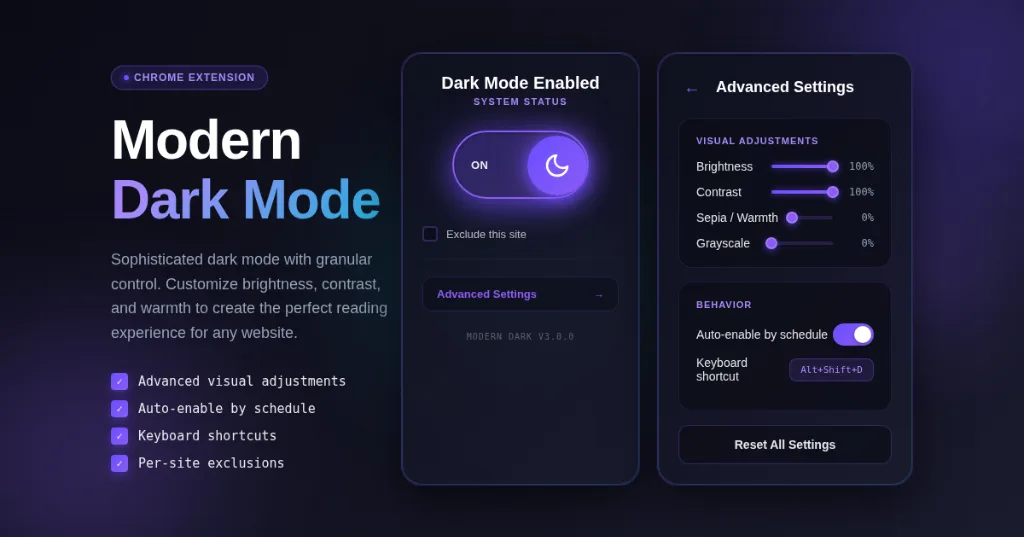
Modern Dark Mode applies these principles automatically. Instead of crude color inversion, it maps colors to a calibrated dark palette that maintains readability without high contrast extremes. The result is dark mode that actually reduces eye strain instead of trading one form of discomfort for another.
If dark mode has been hurting more than helping, the problem isn't the concept — it's the implementation. Try a well-calibrated dark mode extension and feel the difference.