How to Auto Refresh a Webpage Every 30 Seconds in Chrome
Patrick Bushe
January 5, 2026 · 5 min read
Chrome doesn't have a built-in option to auto-refresh a tab on a schedule.
This seems like such a basic feature that people often assume they're missing
a setting somewhere — but there genuinely isn't one. Here are your real options,
ranked from simplest to most powerful.
Option 1: The JavaScript console one-liner
If you just need this once for a session, open the DevTools console (F12)
on the tab you want to refresh and run:
setInterval(() => location.reload(), 30000);
This refreshes the page every 30 seconds (30,000ms) until you close the tab
or navigate away. It stops working if the page reloads and the console
script doesn't persist across reloads — which it usually doesn't.
For a script that survives page reloads, you'd need to use localStorage to
track whether the interval should continue, which turns into a real coding
project quickly.
Option 2: A meta refresh tag (if you control the HTML)
If you're monitoring a page you built, add this to the head section:
<meta http-equiv="refresh" content="30">
This triggers a hard refresh every 30 seconds at the browser level, so it
survives JavaScript restarts. But you need to own the page to add this.
Option 3: Auto-refresh via URL parameter tricks
Some sites accept a query parameter that triggers server-side refresh behavior.
This is rare and site-specific — not a general solution.
The right solution: AutoBrowser
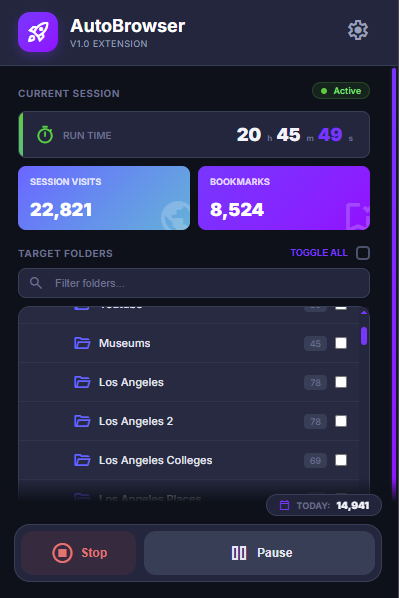
AutoBrowser is a Chrome extension built specifically for automating browser
behaviors including scheduled tab refreshes. It takes 30 seconds to set up
and works reliably across browser restarts.
Setting up a 30-second refresh:
1. Install AutoBrowser from the Chrome Web Store
2. Navigate to the tab you want to auto-refresh
3. Click the AutoBrowser icon in your toolbar
4. Under Refresh, enter 30 in the interval field and select seconds
5. Toggle the refresh switch on
The tab will now refresh every 30 seconds. A small timer badge on the
extension icon shows you the countdown. You can see which tabs have active
refresh rules from the extension popup without switching to each one.
A few things that make AutoBrowser more useful than the console approach:
Persistence: Refresh rules survive browser restarts. If you're monitoring
a deployment dashboard overnight, you set the rule once and don't think
about it again.
Multiple tabs: You can set different refresh intervals on different tabs
independently. One tab refreshing every 10 seconds, another every 5 minutes.
Pause on interaction: AutoBrowser detects when you're actively using a tab
(mouse movement, typing) and pauses the refresh timer so it doesn't interrupt
you mid-read. The timer resumes when you leave the tab.
Conditional refresh: You can set the refresh to only happen when the tab
is in the background (not the active tab). Useful for monitoring tabs you
keep behind your main work.
Refresh vs. reload: the difference matters
A regular reload (F5) sends a new request to the server and discards the
browser cache for that page. A refresh can be either a cache-using reload
or a hard bypass-cache reload (Ctrl+Shift+R). For monitoring live data,
you almost always want a hard refresh to ensure you're seeing the latest
state. AutoBrowser defaults to hard refresh — make sure this matches what
you need.
Using AutoBrowser with Chrome profiles
If you use multiple Chrome profiles (work and personal, or multiple client
profiles), AutoBrowser's refresh rules are stored per-profile. A refresh
rule you set up on your work profile won't be active on your personal
profile. This is generally the right behavior — your work dashboard
refresh rules shouldn't run when you're in personal browsing mode.
Setting up refresh rules that survive browser restarts
The biggest practical advantage of AutoBrowser over console scripts is
the persistence story. When you create a refresh rule in AutoBrowser, it's
saved to the extension's storage and reactivated when Chrome starts.
To make a rule persistent:
1. Create the refresh rule for your tab as described above
2. Open AutoBrowser settings
3. Enable Persist Rules on Restart
4. For the specific rule, enable Auto-Activate — this tells the extension
to automatically start the refresh when Chrome opens, without you
needing to click anything
This is particularly useful for monitoring dashboards and status pages
that you want running as soon as you open your browser in the morning.
Rate limiting and server courtesy
For public websites, be thoughtful about refresh intervals. A 5-second
refresh on a news site is effectively a denial-of-service test — it sends
12 requests per minute from your IP. Most sites won't be affected by a
single user doing this, but it's poor practice and some sites will
rate-limit or block your IP.
For internal tools and self-hosted services you own, short intervals are
fine. For public sites, 30 seconds is a reasonable minimum. For content
that updates hourly (news, pricing), 10-15 minute intervals are plenty.