How to Automatically Cycle Through Browser Tabs on a Dashboard
Patrick Bushe
January 4, 2026 · 5 min read
A rotating dashboard display — cycling through analytics, monitoring panels,
team dashboards, and build status boards — is a staple of dev team offices
and operations centers. Setting this up properly in Chrome takes a few minutes
once you know what you're doing.
The use case
You have 4-6 tabs open: a Grafana dashboard, a GitHub Actions status page,
your Datadog overview, and a Jira board. You want them to cycle on a TV or
monitor, each visible for 30-60 seconds, so the team can glance up and see
current state without anyone managing it.
Native Chrome limitations
Chrome has no built-in tab cycling. You can manually cycle with Ctrl+Tab but
that's obviously not useful for a display that runs unattended.
If all your dashboard pages were under your control, you could implement
cycling in JavaScript — after N seconds, redirect to the next URL. But your
Grafana instance and GitHub aren't pages you can modify. You need the cycling
logic to live in the browser, not the pages.
Setting up tab cycling with AutoBrowser
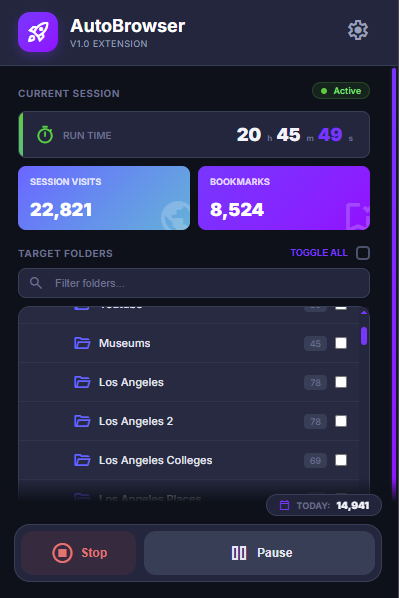
AutoBrowser's tab cycling feature lets you define a rotation sequence and
timer without touching the pages themselves.
1. Open all the tabs you want in the rotation. Order them in the tab bar
how you want them to cycle (AutoBrowser will cycle left to right).
2. Click the AutoBrowser icon and go to Tab Cycle
3. Enable tab cycling and set the interval per tab. You can set a global
interval (same duration for all tabs) or configure per-tab durations
(some dashboards need more time to absorb than others).
4. Optionally, enable Refresh on Activate — each tab gets a hard refresh
right before it becomes active, ensuring you always see live data.
5. Click Start Cycle. The browser will begin rotating through the defined
tabs automatically.
You can pin the cycling state so it survives a browser restart. This is
important for TV displays that run 24/7 — AutoBrowser saves the cycle
configuration and resumes it automatically when Chrome starts.
Kiosk mode for displays
For a dedicated display that shouldn't be touched, combine AutoBrowser's
tab cycling with Chrome's kiosk mode.
For a regular Chrome installation on a display PC:
1. Add the Chrome shortcut argument --kiosk to hide the browser UI:
Right-click the Chrome shortcut → Properties → Target field →
append --kiosk https://your-first-dashboard-url
2. Use AutoBrowser to handle the cycling from there
This gives you a full-screen rotating display with no visible browser chrome.
Note: kiosk mode removes the tab bar, so you'll need to manage the rotation
entirely through AutoBrowser's timer — you can't see or manually switch tabs.
Refresh timing considerations
Dashboards that load heavy datasets (complex Grafana queries, large Datadog
time series) can take 10-20 seconds to fully render after a page refresh.
If you set the cycle duration to 30 seconds and refresh on activate, you're
only getting 10-20 seconds of actually readable data. Either increase the
duration per tab or test how long each dashboard takes to load and factor
that in when setting intervals.
Using AutoBrowser with Chromium-based browsers
AutoBrowser works on any Chromium-based browser that supports Chrome
extensions — this includes Edge, Brave, and Arc. The setup process is
identical to Chrome: install from the Chrome Web Store (most Chromium
browsers support this) and the extension runs with full functionality.
For tab cycling dashboards running on a corporate Edge deployment,
this is particularly useful since Edge is often the managed default.
Handling authentication-protected dashboards
If your Grafana or Datadog requires login, the tab cycling setup needs to
account for session expiry. Most enterprise monitoring tools have configurable
session timeout — set it to a long value (8-24 hours) for display machines
that use a dedicated service account.
For tools that enforce short sessions for security reasons, AutoBrowser's
auto-click feature can be combined with the tab cycling: set up a click
rule on each dashboard tab that targets a non-destructive UI element (like
the main content area) at an interval shorter than the session timeout.
This keeps the session alive while the tabs rotate.
Multiple rotation groups
For more complex setups — say you want a morning rotation (standup metrics)
and an afternoon rotation (build pipelines) — AutoBrowser supports named
rotation groups. Define each group with its own set of tabs and timer,
then switch between them manually or set them to activate on a schedule.
This is an advanced use case but it's useful for teams that use a shared
display for different contexts throughout the day.
The display machine setup
For a dedicated TV or monitor running a dashboard display, using a
Chromebook in managed kiosk mode is often the most stable long-term solution.
Chromebooks handle unattended operation well, automatic updates, and
don't require you to maintain a Windows or macOS machine just for a display.
AutoBrowser works on ChromeOS the same as it does on desktop Chrome.