Monitor Website Changes Without Manually Checking Every Hour
Patrick Bushe
January 4, 2026 · 5 min read
You're waiting for a job posting to update, a limited-edition item to come
back in stock, a government portal to publish results, or a competitor's
pricing page to change. Manually refreshing every hour burns time and you'll
miss the update the moment you take a break.
This is a solved problem — but the solution depends on what you're trying
to monitor and how fast you need to know.
Option 1: Server-side monitoring tools
For critical monitoring, a server-side service is most reliable. Tools like
VisualPing, Distill.io, or Wachete check pages from their servers on a
schedule and email or Slack you when content changes. The advantage: they
work even when your browser is closed.
The downside: free tiers have significant limitations (check frequency
restricted to every few hours, limited number of watched pages). Paid plans
run $10-30/month, which is reasonable for professional use but overkill
for occasional monitoring.
Option 2: RSS feeds (when available)
Many sites that update regularly publish RSS feeds even if they don't
advertise them. Check for /feed, /rss.xml, or /atom.xml at the root of the
domain. If the site uses WordPress, the feed is almost always at /feed/.
A local RSS reader like NetNewsWire (macOS) or Fluent Reader (Windows/Linux)
can notify you when new items appear without any server infrastructure.
This only works for content published as discrete articles or entries.
It doesn't help for monitoring a single page's content (like a price or
a status indicator).
Option 3: AutoBrowser for browser-based monitoring
For monitoring pages you need to watch while your computer is running,
AutoBrowser provides tab-level change detection alongside its auto-refresh
capabilities.
How it works:
1. Navigate to the page you want to monitor
2. Open AutoBrowser and enable change detection for the current tab
3. Optionally, highlight a specific element on the page to watch — rather
than the whole page, you can focus on a price, a status field, or a
specific section
4. Set the refresh interval (every 5 minutes is reasonable for most use cases)
5. Choose the notification behavior: badge update, browser notification,
or both
When AutoBrowser detects that the monitored content has changed after a
refresh, it sends a Chrome notification and highlights the changed section
so you can see exactly what's different.
Best practices for reliable monitoring
Be specific about what you're watching. Monitoring the entire page body
produces false positives — banner ads, rotating hero images, online user
counters, and timestamps all change constantly. Pin the watch target to
the specific content you care about.
To select a specific element in AutoBrowser:
1. Click Select Element in the extension popup
2. Move your cursor over the page — elements highlight as you hover
3. Click the element you want to watch (a price span, a status badge, etc.)
4. AutoBrowser records the CSS selector path and watches only that element
Set realistic intervals. Most content that matters (pricing, availability,
news) updates at most a few times per hour. A 5-minute interval is plenty
for most use cases. Very short intervals (under 30 seconds) on sites that
don't handle load well can result in your IP getting rate-limited.
Keep the monitored tab open but in the background. AutoBrowser needs the
tab present in Chrome to function — it can't monitor pages while the
browser is closed. For that level of monitoring, use one of the server-side
tools mentioned above.
Notification management
If you have multiple pages being monitored simultaneously, change
notifications can pile up. AutoBrowser's notification settings let you
configure a digest mode — instead of a notification per-change, it batches
changes over 15 minutes and sends a single summary. This is less immediate
but much less disruptive if you're actively working and have several
monitored pages.
Setting up a monitoring dashboard
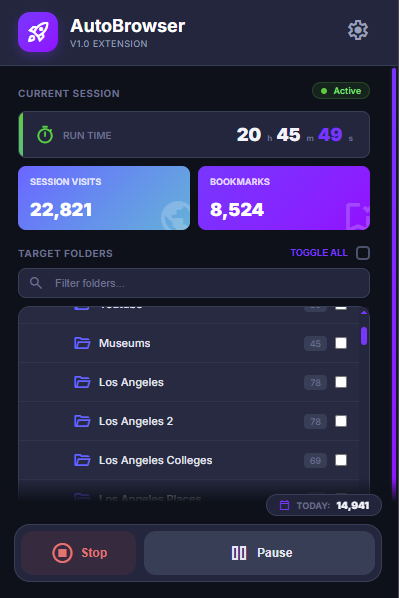
If you're monitoring several pages at once, treat AutoBrowser's main popup
as your monitoring dashboard. It shows a list of all active watch rules,
the last-checked time, and whether any changes were detected. Before
checking the actual pages, glance at the popup first — if nothing is
flagged as changed, you can skip reviewing those pages entirely and
focus on the ones with detected changes. This reduces the time you
spend babysitting pages that haven't changed.
Combining monitoring with calendar or task tools
For time-sensitive monitoring (job posting that closes Friday, product
launching Thursday), consider creating a calendar reminder that coincides
with your monitoring setup. AutoBrowser handles the automated checking
while the calendar reminder ensures you actually review any flagged changes
before the deadline. Automated monitoring can lull you into passive waiting
— pairing it with an active deadline reminder closes the loop.
For stock availability specifically, many e-commerce sites load inventory
status via API calls rather than in the initial HTML. If AutoBrowser isn't
detecting changes you're seeing manually, try a longer refresh interval
(30-60 seconds) to allow dynamic content to fully load before AutoBrowser
takes its snapshot.