Why Google Search Results Are Full of Reddit and Quora Spam
Patrick Bushe
December 31, 2025 · 5 min read
If you've noticed that Google search results in 2024 and 2025 started looking
like Reddit's front page, you're not imagining it. There's a specific reason
this happened — and it's getting worse, not better.
What changed in Google's algorithm
Google has been battling AI-generated content farms since 2023. Sites that
used to rank well for informational queries got penalized as low-quality AI
content flooded those niches. In response, Google's algorithm shifted heavily
toward user-generated or experience-based content signals.
The reasoning: a real Reddit thread with real people sharing real experiences
is more trustworthy than an AI-written article on a content farm. This is
generally true for certain query types — product recommendations from
actual users are often more useful than affiliate listicles.
But the pendulum swung too far. Google's algorithm now treats Reddit, Quora,
TripAdvisor, and similar platforms as high-authority sources across the board,
ranking them for queries where a specific technical article, primary source,
or official documentation would be far more useful.
A developer searching for TypeScript generic constraints doesn't want a
Reddit thread — they want the official TypeScript docs or a well-sourced
tutorial. But Reddit results appear anyway because the algorithm scores
the domain authority, not the content quality for that specific query.
The other factor: Google's Reddit deal
In 2024, Google signed a significant data licensing deal with Reddit to train
its AI models on Reddit content. This created a perverse incentive structure:
the more Reddit content appears in Google search results, the more data
Google can surface in its AI systems. Critics have pointed out that this
could explain why Reddit results have become prominent even in contexts
where they're not particularly useful.
This isn't confirmed by Google, but the timing correlation is notable.
How to get cleaner search results
The quick approach: add -site:reddit.com -site:quora.com to your search.
This syntax tells Google to exclude those domains from results:
typescript generic constraints -site:reddit.com -site:quora.com
Obviously, typing this for every search isn't sustainable.
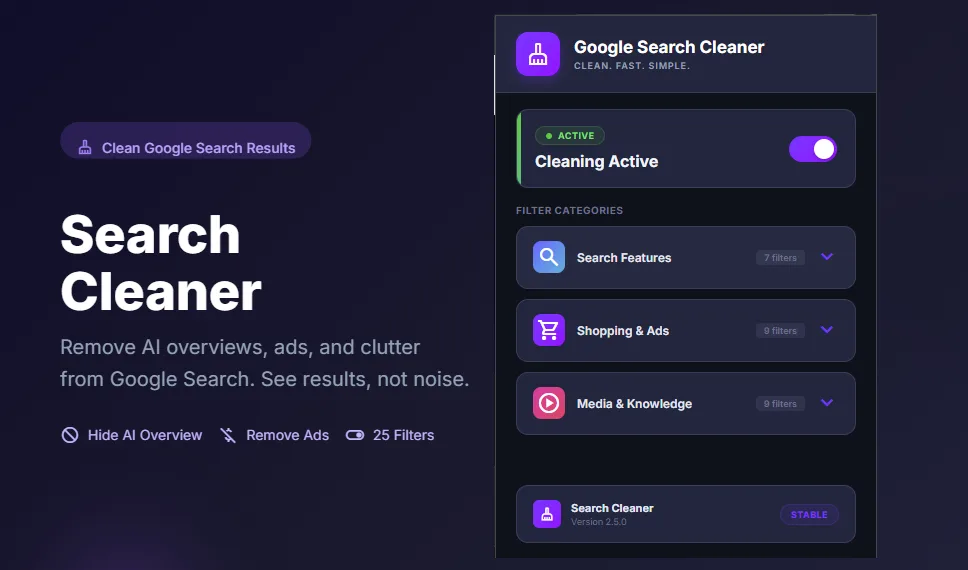
A more permanent solution: Search Cleaner
Search Cleaner lets you define persistent domain exclusions that apply
automatically to every Google search without modifying your search terms.
To exclude Reddit and Quora:
1. Open Search Cleaner settings
2. Go to Domain Filter
3. Add reddit.com and quora.com to your exclusion list
4. All future Google searches will automatically include -site: exclusions
for those domains
You can be more nuanced — maybe you want Reddit results for product
recommendation searches but not for technical documentation searches.
Search Cleaner supports conditional rules based on query patterns, though
this is an advanced feature that requires some setup.
For most people, the simpler approach works: exclude the domains entirely
and accept that you'll occasionally miss a genuinely useful Reddit thread.
You can always run the search without exclusions if Reddit is what you want.
Other useful exclusions to consider:
- pinterest.com (decorating and design searches are often Pinterest-flooded)
- tripadvisor.com (travel searches, if you prefer direct booking sites)
- answers.yahoo.com (Yahoo Answers was shut down but ghost pages still index)
The underlying issue — Google's search quality — isn't something any
extension can fix. But controlling which domains show up in your results
is a meaningful workaround while the algorithm continues to overweight
these platforms.
The information quality problem underneath
Removing Reddit from results doesn't fix the root problem: Google is
struggliing to rank content by quality rather than by authority and
engagement signals. The algorithm shift toward UGC is a symptom of Google
trying to filter AI-generated content, but the collateral damage is
the signal degradation for professional and technical queries.
For now, the practitioner's answer is to use domain exclusions for
categories of search (technical docs, product specs, research) while
keeping UGC accessible for categories where community experience
genuinely helps (product recommendations, subjective comparisons, how-do-
people-actually-use-this questions).
Building a domain exclusion list that actually works
If you want to exclude Reddit and Quora but still occasionally want them,
a practical approach is to create two search engine shortcuts in Chrome:
one that includes the exclusions for your default professional searches,
and one without exclusions for when you specifically want forum results.
- In Chrome Settings → Search Engine → Manage, add a new search engine:
- Name: Google (no Reddit)
- Shortcut: gn
- URL: https://www.google.com/search?q=%s+-site:reddit.com+-site:quora.com
Now typing gn in the address bar triggers Google search with those
domain exclusions. Your default Google search (typing g) works normally.
This gives you per-query control without having to open extension settings.
The quality signal Google is actually missing
The core problem isn't Reddit specifically — it's that Google has no good
signal for content quality within high-authority domains. A Reddit post
with 2 upvotes from 2019 ranks the same as one with 5,000 upvotes from
last month. A Quora answer from an actual expert is indistinguishable,
algorithmically, from a made-up one.
Until Google develops better per-post quality signals within UGC platforms,
the domain-level exclusion workaround remains the most practical approach.