How to Get Back the Old Google Search Layout Without AI
Patrick Bushe
December 30, 2025 · 5 min read
Google's search results page has accumulated a lot of layers over the past
few years. What used to be a clean list of ten blue links is now a scrolling
wall of: AI Overview → sponsored results → People Also Ask accordion →
knowledge panel → shopping carousel → more sponsored results → actual
organic results.
The organic results — the ones you're actually searching for — start
anywhere from 40-70% down the page on a typical query. On mobile, you
can scroll through an entire screen of Google-injected content before
reaching a single organic result.
Here's how to strip most of it away.
What you can and can't control
You can't block Google's servers from sending you this content — the page
loads with all of it included. What you can do is hide it after it loads,
either via URL tricks that request a different results format, or via CSS/DOM
injection that hides elements from your view.
- Things that can be hidden:
- AI Overview block
- People Also Ask (PAA) accordion sections
- Shopping ads and carousels
- Knowledge panel (the box on the right side)
- Related searches sections
- Video results panels (for non-video searches)
- Things that can't be easily removed:
- Paid search ads (these are mixed into organic results and share similar
- HTML structure — hiding them risks hiding real results too)
- Featured snippets (Google's answer box at the top for simple factual queries)
Using Search Cleaner to restore a clean layout
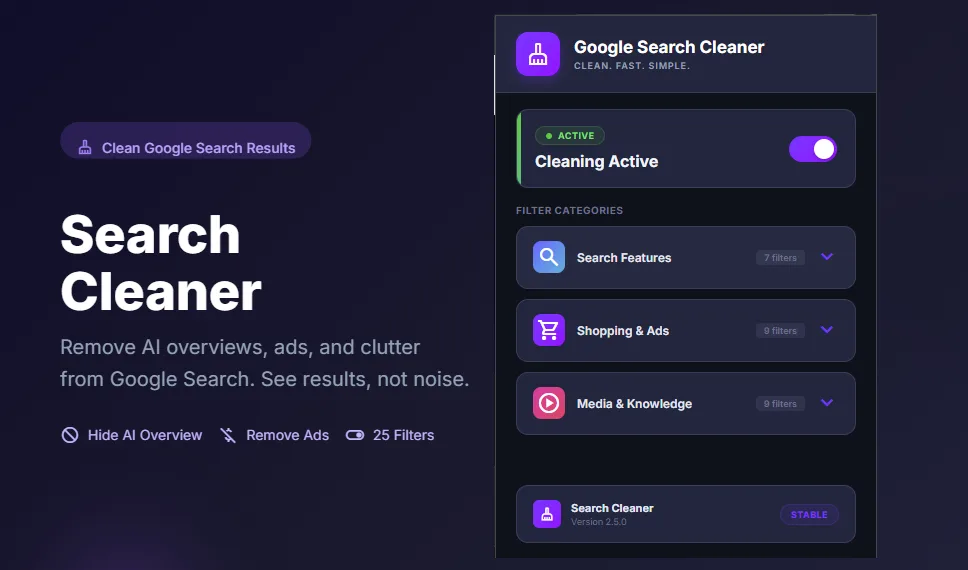
Search Cleaner applies a configurable set of CSS and DOM rules to Google
search pages that hides the non-result elements.
- After installing from the Chrome Web Store, the default configuration hides:
- AI Overviews
- People Also Ask sections
- Most promotional content
- For a more aggressive cleanup, open Search Cleaner settings and enable:
- Hide Knowledge Panel — removes the right-side info boxes
- Hide Video Panel — removes embedded YouTube results for non-video queries
- Compact Result Density — tightens the spacing so more results fit
- on screen (Google increased line spacing in 2024, making it feel even
- more padded)
- Hide Related Searches — removes the related search suggestion blocks
- that appear mid-page
The result is close to the classic 10-blue-links layout: a list of titled
links with URL and description, minimal decoration.
Some trade-offs
Knowledge panels are worth keeping for simple factual queries — the quick
answer boxes are genuinely useful there. You can configure Search Cleaner
to show panels for short queries (under 4 words) and hide them for longer,
more research-oriented searches.
People Also Ask is another double-edged feature. It's clutter when you know
exactly what you're searching for. But for exploratory research, the PAA
questions often reveal angles you hadn't considered. Some people prefer to
hide it by default and only expand it manually when needed.
Search Cleaner's toggle button in the Chrome toolbar lets you flip between
clean and default modes quickly — useful if you sometimes want the full
Google experience and sometimes want the stripped-down version without
changing your settings.
Search operators as a complement
Search Cleaner's visual cleanup works well alongside manual search
operators. Some operators worth knowing for getting cleaner results:
- intitle:"keyword" — only results where the keyword is in the page title
- after:2024 — only results from 2024 onward (useful for current information)
- filetype:pdf — only PDF results (great for finding whitepapers and reports)
Combine these with Search Cleaner's domain exclusions for highly targeted
result sets. For developer documentation searches, something like:
"error handling" intitle:"documentation" after:2024
...combined with Search Cleaner removing AI Overviews gives you current
doc pages without the noise.
Performance impact
Search Cleaner hides elements after the page loads — it doesn't block
network requests. This means Google still sends all the AI content,
all the shopping cards, all the panels. The extension then hides them
with CSS. Page load time is not improved; what improves is your time
to finding relevant results.
If page load performance is a concern (slow network, older machine),
combine Search Cleaner with uBlock Origin, which can block some of
Google's ad-related resources at the network request level before they
ever reach the DOM. The combination of network-level blocking and
DOM-level hiding gives you both faster loads and cleaner results.
What Google considers a successful search
A useful mental model: Google's success metric for search is whether
you click on a result. If you find your answer in the AI Overview and
don't click any external links, Google considers that a successful search
— but the websites that created the information Google summarized got
no traffic. This is the long-term sustainability problem with AI-first
search that many publishers are concerned about.
By hiding AI Overviews and clicking through to actual sources, you're
contributing to a healthier information ecosystem, not just getting
better search results for yourself.