How to Remove Google AI Overview From Search Results in 2026
Patrick Bushe
January 1, 2026 · 5 min read
Google's AI Overview feature has expanded significantly and now appears at the
top of search results for a huge percentage of queries. For some searches it's
helpful. For many — especially when you're debugging code, researching a
specific product, or looking for primary sources — it adds a wall of
AI-generated text between you and the actual search results.
Here are every available method for removing or hiding it, from least to
most effort.
Method 1: The udm=14 parameter
The fastest hack: append &udm=14 to any Google search URL, or set your
browser's search engine to include it by default.
In Chrome, go to Settings → Search Engine → Manage search engines → Edit
your Google entry, and change the URL to:
https://www.google.com/search?q=%s&udm=14
This activates Google's Web search filter, which shows only web results
without AI Overview, people also ask, knowledge panels, or most of the other
SERP features. It's not officially documented as an AI-removal feature but
that's effectively what it does in 2026.
Downside: udm=14 also strips some genuinely useful features like image
previews, quick facts for simple queries, and local business info. For certain
searches you'll find yourself wanting those features back.
Method 2: Search settings
Google added a somewhat hidden option to disable AI Overview:
1. Search for anything on Google
2. Click Search Settings (top right of the page, or via the gear icon)
3. Look for AI Overview → Don't show AI Overviews
This is tied to your Google account. If you're not signed in, it resets.
If you switch browsers, the setting doesn't follow you.
As of 2026, this setting also intermittently fails — Google has been observed
re-enabling AI Overview after browser updates or in incognito windows.
Method 3: Search Cleaner extension
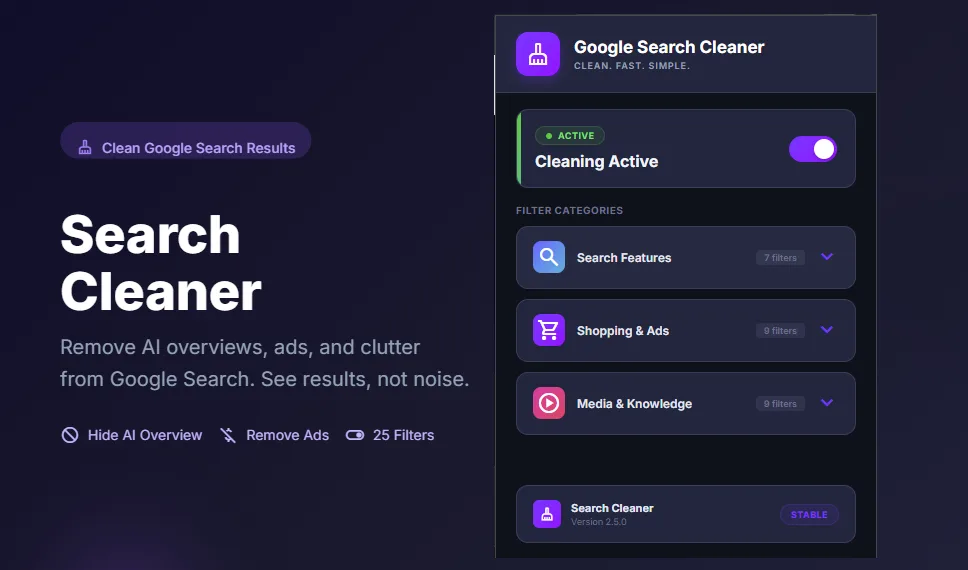
Search Cleaner is a Chrome extension that removes AI overviews, sponsored
results, and other SERP clutter at the DOM level on every search, on every
browser profile, signed in or not.
Installing and configuring it:
1. Install Search Cleaner from the Chrome Web Store
2. The AI Overview is hidden by default as soon as you install it
3. Open the extension settings to customize what else gets removed —
People Also Ask, knowledge panels, shopping ads, etc.
Search Cleaner uses CSS selectors and DOM observation to detect and hide
Google's injected UI components. Because it works at the browser DOM level
rather than the URL level, it survives Google A/B tests (where the same
query might show AI Overview in one session and not another) and works
regardless of whether you're signed in.
The extension doesn't block requests to Google — it lets the full page load,
then hides specific elements. This means Google's servers still receive your
search query, but your visual experience is clean.
Choosing the right approach
For most users, Search Cleaner is the most reliable option because it doesn't
require per-session configuration and works across different search contexts
(including when Google ignores your saved settings, which happens more often
than it should).
The udm=14 parameter is worth using in combination as a belt-and-suspenders
approach — it reduces the chance of AI-generated content loading at all,
rather than loading and being hidden.
Using Search Cleaner alongside uBlock Origin
Search Cleaner and uBlock Origin serve different functions and work well
together. uBlock operates at the network request level — it blocks certain
resource requests before they're downloaded. Search Cleaner operates at
the DOM level — it hides elements after they've been loaded.
For Google Search specifically, uBlock can block some third-party tracking
scripts Google loads alongside search results, while Search Cleaner handles
the visual cleanup of SERP features. Running both gives you both faster
page loads and cleaner result presentation.
Keeping up as Google changes its layout
Google regularly changes the HTML structure of its search results page,
which can break extension-based approaches when the extension's CSS selectors
no longer match the renamed elements. Search Cleaner's maintainers update
the selectors when Google makes structural changes, so keeping the extension
updated is important.
If you install Search Cleaner and notice AI Overviews still appearing,
the extension may be running an outdated selector set against a recently
redesigned SERP. Check for an extension update in the Chrome Web Store
and reload the search results page after updating.
Incognito mode behavior
By default, Chrome extensions don't run in incognito mode unless you
explicitly grant permission. To enable Search Cleaner in incognito:
1. Go to chrome://extensions
2. Find Search Cleaner and click Details
3. Enable Allow in Incognito
This is particularly useful if you frequently search in incognito to avoid
personalized results — without this setting, you'd get AI Overviews in
incognito even with the extension installed.
What about Bing and other search engines
Search Cleaner focuses on Google, but Bing has also introduced AI-generated
answers (Copilot responses) that push organic results down. The extension
doesn't currently support Bing, but the udm=14 equivalent for Bing is
to use the vertical navigation tabs to select Web, which removes most
AI-generated content from the results.