Remove People Also Ask Boxes From Google Search Results
Patrick Bushe
December 28, 2025 · 5 min read
People Also Ask (PAA) boxes appeared in Google search results around 2015
and have expanded significantly since. What started as one or two questions
per search page is now often four or more expandable question accordions,
scattered throughout the results — sometimes between every two organic links.
Why people want to hide them
The PAA boxes add a lot of vertical real estate to the page without
contributing what most people are looking for: actual links to pages with
the information. The questions are useful for exploratory searches where
you're not sure what you're looking for — but for specific, targeted queries,
they're noise that pushes your results further down.
For long-tailed technical searches specifically (programming questions, product
spec lookups, academic topics), the PAA questions are often less specific
than your actual query and pull in a different direction. They feel like
Google trying to suggest you search for something else.
Method 1: The URL approach
Adding &tbs=li:1 to a Google search URL filters for verbatim results,
which tends to reduce PAA boxes. Combined with &udm=14 (web results only),
you get a fairly clean page:
https://www.google.com/search?q=YOUR+QUERY&udm=14&tbs=li:1
This isn't a guaranteed PAA remover — Google shows them inconsistently
depending on the query — but it helps.
Method 2: Search Cleaner
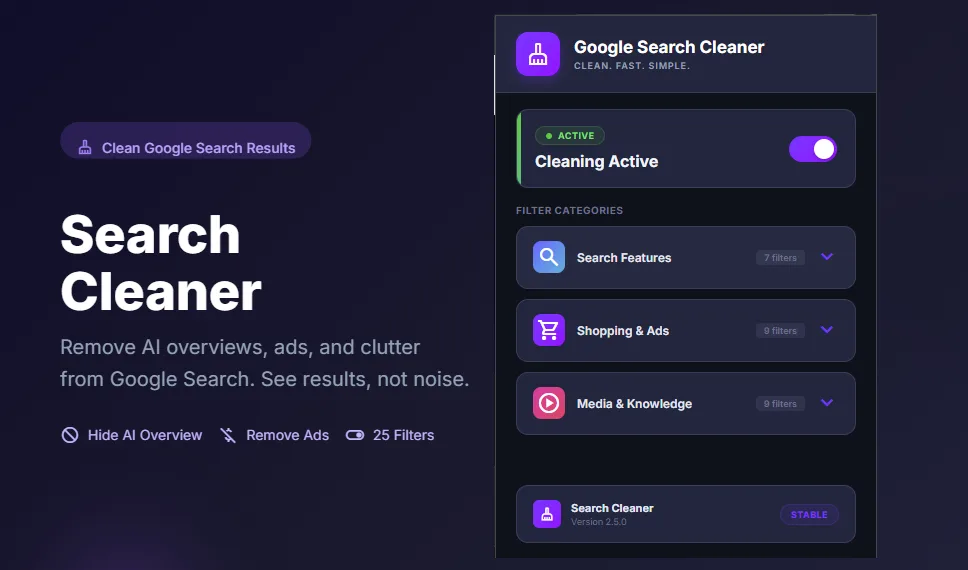
Search Cleaner handles this more reliably than URL parameters. After installing
the extension:
1. Open Search Cleaner settings
2. Enable Hide People Also Ask — this is on by default in newer versions
3. The PAA accordions are hidden on all future Google searches
The underlying web page still loads the PAA content (Search Cleaner doesn't
block the network requests), but the elements are hidden via CSS. This means
the page load time isn't improved, but your visual experience is cleaner.
If you occasionally want to see PAA boxes (they can be useful for content
research or finding related subtopics), Search Cleaner's toolbar icon lets
you toggle all rules on/off for the current page with one click. Your
permanent settings aren't changed — it's just a temporary override.
Why Google won't let you turn this off natively
Google's search settings have remarkably few options for controlling
result layout. The reason is structural: PAA boxes, knowledge panels,
AI Overviews, and shopping carousels are Google's way of keeping users
on Google's pages longer rather than clicking through to external sites.
Removing them reduces Google's engagement metrics, so there's no incentive
for Google to offer a built-in removal option.
Extensions like Search Cleaner exist precisely because Google doesn't
provide this control. As long as Google's search page is rendered HTML
that a browser can modify, client-side extensions can reshape it.
PAA and voice search optimization
People Also Ask questions are closely correlated with voice search queries.
Voice assistants (Google Assistant, Siri) answer conversational questions
that closely match PAA phrasing. If you're doing content research for a
site you own, the PAA boxes reveal exactly which conversational queries
Google associates with your topic — and writing content that directly
answers those questions improves your chances of appearing in voice
search results and featured snippets.
For power users: creating a PAA research shortcut
Keep a separate Chrome profile (or use incognito with extensions disabled)
purely for content research when you want full SERP data including PAA.
Your main profile runs Search Cleaner for clean day-to-day search, while
the research profile shows the full layout for intentional analysis.
This separation means you never accidentally switch into research mode
during a regular search session.
Using keyboard shortcuts in Search Cleaner
Search Cleaner's toolbar toggle button is the fastest way to switch
between clean and default Google views, but if you prefer keyboard-driven
workflow, you can assign a keyboard shortcut to the extension via
chrome://extensions/shortcuts. Set a comfortable key combination
(Alt+S works well on most systems) and you can toggle the extension's
rules on or off without reaching for the mouse.
For content creators: why PAA matters
If you create content online, People Also Ask boxes are actually worth
studying before you hide them. PAA questions are generated from real
search queries and they reveal the specific sub-questions people ask
around your topic. A blog post that answers all the PAA questions for
a given topic tends to rank well because it covers the full semantic
field Google associates with that search.
The workflow: search your target keyword without Search Cleaner to see
the PAA questions, note them, then re-enable the extension for your
normal reading. Many content strategists do exactly this — review PAA
for research purposes, then hide it for productivity.
Some PAA boxes that are worth keeping
Not all PAA content is noise. For broad, exploratory searches — researching
a topic you don't know well, looking at an industry for the first time —
the related questions can be more valuable than the individual links.
They help you discover the vocabulary and sub-topics you didn't know to
ask about.
A nuanced approach: enable PAA for short queries (under 3 words) where
exploration is likely, and disable it for long queries (4+ words) where
you know what you're looking for. Search Cleaner's query-length conditional
rule supports this if you're willing to set it up in the advanced settings.