How to Hide Google Shopping Ads in Search Results
Patrick Bushe
December 27, 2025 · 5 min read
Search for almost any product on Google and you'll get a sponsored shopping
carousel above the fold — a row of images with prices that looks like organic
product listings but is paid placement. Below that, you get more shopping ads
labeled Sponsored in small text. Then, potentially, some organic results.
For research purposes — comparing products, reading reviews, understanding
the market — this layout isn't ideal. You want the review articles and
independent comparisons, not the paid placements from vendors who can afford
Google's advertising costs.
What Google Shopping actually is
Google Shopping is a paid advertising channel. Merchants pay to appear in
the shopping carousel. The products shown are not ranked by quality or
relevance to your query — they're ranked by bid amount, ad quality score,
and budget. A better product from a smaller vendor that doesn't advertise
on Google won't appear in the shopping results.
The organic product results (which appear below all the shopping content)
are more useful for research because they're ranked by relevance and domain
authority rather than advertising spend.
Method 1: Use Google Shopping's own filter to exit shopping mode
If you're searching on google.com and see a shopping carousel, you can
sometimes click Web in the filter tabs at the top to switch to pure web
results. This often removes the shopping carousel.
This isn't reliable — Google decides whether to show the Web tab based on
your query type, and it may not appear for product searches where Google
judges shopping results to be relevant.
Method 2: The site exclusion workaround
Adding -inurl:shopping -site:google.com/shopping to your search can
reduce shopping results appearing. It's imperfect but reduces some of
the most prominent shopping placements.
Method 3: Search Cleaner
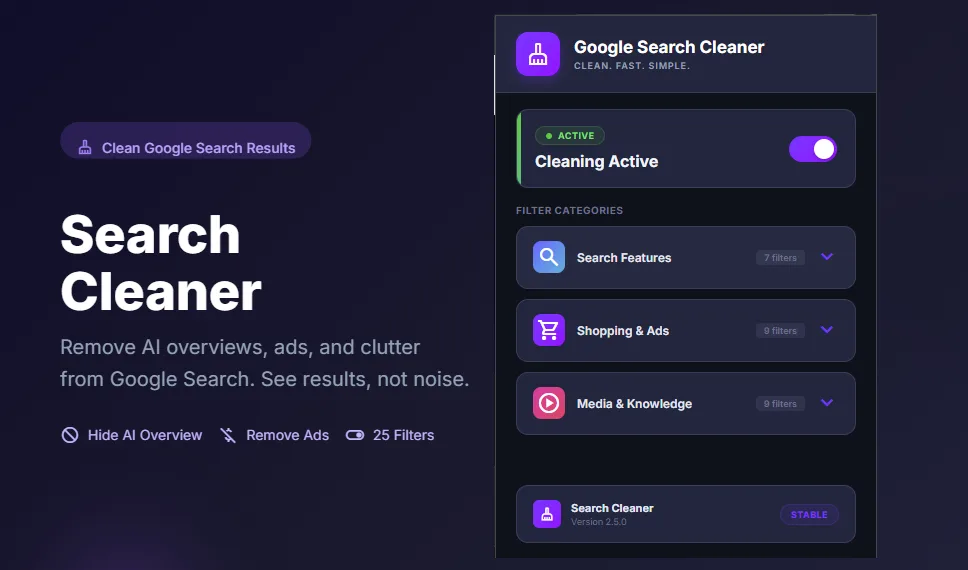
Search Cleaner specifically targets Google Shopping carousels and sponsored
product blocks. The extension identifies these blocks by their HTML structure
(which Google marks with specific data attributes) and hides them on page load.
In Search Cleaner settings:
1. Enable Hide Shopping Carousel — removes the horizontal scrollable
product images at the top of product searches
2. Enable Hide Sponsored Products — removes in-line sponsored product
listings that appear within organic results
3. Optionally enable Mark Sponsored Text Ads — rather than hiding text
ads (standard AdWords-style results), this adds a visual indicator that
makes them more obvious rather than removing them. Useful if you want
to know they're ads without hiding them entirely.
The shopping results tab (google.com/shopping) is not affected — if you
specifically navigate to the Shopping tab, you're opting into a shopping
experience and the extension respects that intent.
For product research specifically
If you're researching a product purchase, the best combination is:
1. Remove shopping carousels (they're ads, not unbiased results)
2. Keep text ads visible but marked (they can occasionally point to
useful retailer pages)
3. Remove People Also Ask (keeps your research focused)
4. Keep featured snippets (for simple spec questions they're useful)
This leaves you with organic web results for the query — which is typically
where the review articles, comparison guides, and forum discussions live.
Verifying organic vs. sponsored results
One challenge with hiding sponsored products is accidentally hiding
organic product listings that have a superficially similar structure.
Search Cleaner uses Google's own data attributes to distinguish sponsored
from organic — Google marks ad elements with specific attributes for
their own internal tracking, and Search Cleaner reads these to ensure
it's only hiding confirmed paid placements.
If you notice organic results disappearing after installing Search
Cleaner, open the settings and check that only the Shopping Carousel
and Sponsored Product rules are active — not any aggressive ad-blocking
rule that might misidentify organic results. You can report misidentified
elements through the extension feedback mechanism to help improve the
selector accuracy.
Price comparison and affiliate content
One more dimension of the Google Shopping problem: the organic product
results that appear below shopping ads are often dominated by affiliate
content — listicles like 10 Best Running Shoes that are SEO-optimized
for commission clicks, not genuine editorial quality.
For product research, a more reliable approach is to combine Search
Cleaner (to remove shopping ads and reduce affiliate spam) with specific
site searches. Adding site:reddit.com to your query — yes, intentionally
including Reddit in this case — often surfaces the genuine user experience
discussions that affiliate sites bury.
The paradox: Reddit is both overrepresented in general results (thanks to
Google's algorithm shift) and genuinely useful when you specifically want
peer experience with a product. The answer is control: be able to exclude
Reddit by default and include it on purpose when it serves your research.
Why merchants buy shopping ads
A final note worth understanding: Google Shopping ads exist because they
work for merchants. The first few positions in the shopping carousel get
a meaningful percentage of product-related clicks. If a merchant doesn't
advertise, they're effectively invisible to many buyers. This creates a
situation where any product category with advertising competition has its
listing dominated by whoever spends the most, not whoever has the best
product. Removing the shopping ads from your view doesn't hurt merchants
you want to buy from — the organic results often include the same or
better vendors.