How AI Summaries Affect Reading Comprehension and Critical Thinking
Patrick Bushe
June 21, 2024 · 5 min read
AI summaries are everywhere: at the top of search results, in email apps, in browser sidebars. They save time. The question is what happens to understanding and judgment when summaries replace reading. Research is early, but it points in a consistent direction.
What studies have found so far
- A 2025 study by Microsoft Research and Carnegie Mellon University, surveying 319 knowledge workers, found that people who trusted generative AI more reported using less critical thinking on tasks where they used it.
- A 2025 MIT Media Lab study, released as a preprint with 54 participants, found lower brain engagement and weaker recall of their own essays among people who wrote with ChatGPT. It's small and not yet peer-reviewed, so treat it as a signal, not a conclusion.
Older learning research also helps: people remember more when they work to produce or explain information themselves, and less when it's handed to them ready-made.
What gets lost in a summary
- Nuance: caveats, exceptions and "it depends" are the first things cut.
- Evidence: you see the conclusion without the data behind it.
- Disagreement: summaries tend to present one view, even when experts differ.
- Errors: AI summaries sometimes misstate or invent details. See how AI Overviews get answers wrong.
- Context: who wrote it, when, and why.
When summaries are fine
- Deciding whether something is worth reading in full.
- Getting the gist of low-stakes material.
- Catching up on long email threads you'll act on anyway.
Using summaries without losing your edge
- Preview, then read: use the summary as a map, then read the original for anything important.
- Summarize first yourself, then compare with the AI's version.
- Ask for the other side: request counterarguments or limitations.
- Check sources: open the pages a summary cites.
- Keep reading long-form regularly, so the skill doesn't fade.
For teachers and parents
Students benefit from writing their own summaries and explaining ideas in their own words before using AI tools. See AI tools for teachers and students.
Choosing when you see summaries
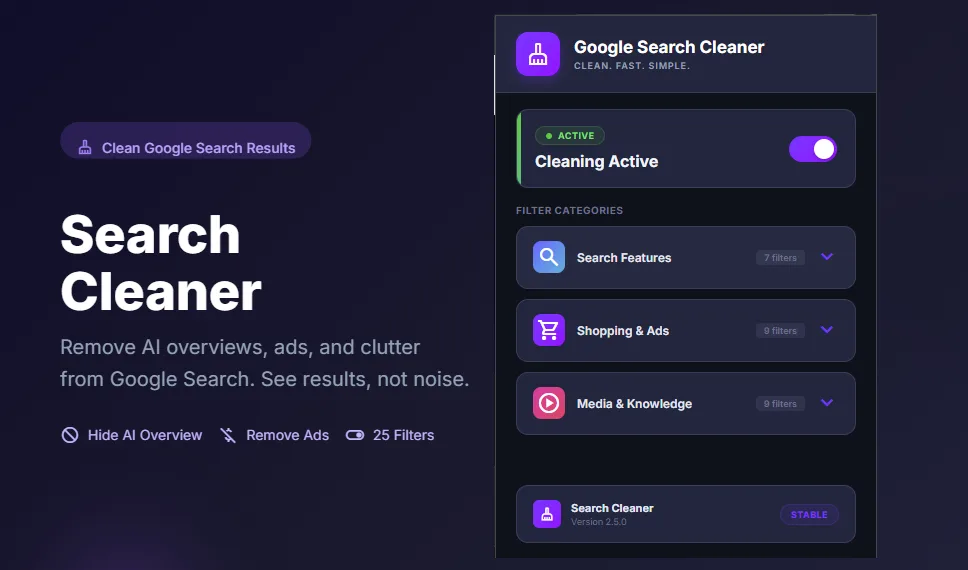
Search Cleaner hides Google's AI Overviews and other sections you choose, so you can decide when to read a summary instead of seeing one first. See also what research says about reading comprehension.