How to Monitor Uptime of Your Own Website From Chrome
Patrick Bushe
July 6, 2025 · 5 min read
You can watch your website from Chrome, but a browser tab only checks while your computer is on and you're looking at it. For real uptime monitoring, use an outside service that checks your site every few minutes and alerts you. Chrome is still useful for watching dashboards and diagnosing problems.
Use an uptime monitoring service
Services such as UptimeRobot, Better Stack and Pingdom check your site from servers around the world on a schedule, and email or text you when it goes down. Most have a free tier that covers a small site.
- Monitor your homepage and one or two important pages, such as checkout or login.
- Add a keyword check where possible, so the monitor confirms a word on the page appears, not just that the server answered.
- Monitor your SSL certificate and domain expiry dates too; both cause outages that are easy to prevent.
- Set alerts to reach you where you'll actually see them.
What Chrome is good for
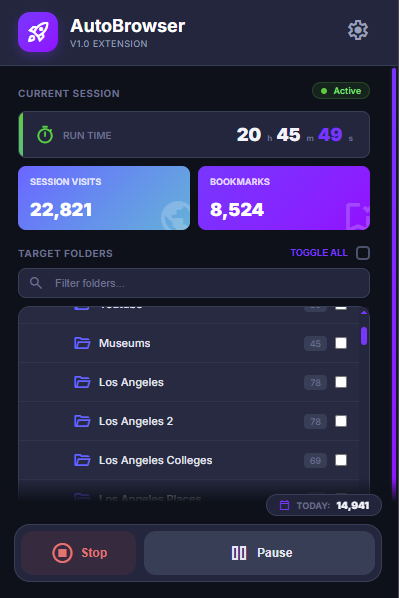
- Keeping dashboards in view. AutoBrowser plays the pages in a bookmark folder one after another in a single tab on a timer, and loops. Put your status page, analytics and monitoring dashboards in a folder and leave it running on a spare screen. A folder with one bookmark simply reloads that page on your timer. It doesn't detect errors itself; the dashboards do that.
- Checking a problem. Open DevTools (
F12), go to the Network tab and reload. The status column shows each request's response code: 200 is fine, 500s are server errors, 404 is a missing page. - Testing from elsewhere. If the site works for you but not for others, a "down for everyone or just me" checker tells you which.
When your site goes down
- Check your host's status page for a wider outage.
- Check whether your domain or SSL certificate expired.
- Look at recent changes: an update, plugin or deployment just before the outage.
- Contact your host with the time the outage started and any error codes.
Keep a simple log
Note each outage: when it started, how long it lasted and the cause. Patterns, such as outages at the same time each night, often point to a backup job or a traffic spike. For pages that fail and recover, see how to reload a page automatically when it shows an error.
Don't overload your own site
Refreshing a page every few seconds from several tabs can add load on a small server. Every one to five minutes is plenty for watching a dashboard. See auto-refresh extensions compared.