Will AI Replace Search Engines Entirely: An Evidence-Based Assessment
Patrick Bushe
July 11, 2024 · 5 min read
AI chatbots have grown fast, but search engines haven't disappeared. The more likely future is the one already happening: search engines adding AI, and AI tools adding search, until the line between them blurs.
The growth of AI tools
- OpenAI said in October 2025 that ChatGPT had about 800 million weekly users, and ChatGPT now searches the web for current answers.
- AI-first search tools such as Perplexity answer questions with cited sources.
- Many people now ask a chatbot first for explanations, comparisons, writing help and planning.
Search engines are still huge
- Google still handles billions of searches every day.
- Google added AI Overviews in 2024 and AI Mode in 2025, so a lot of AI answering now happens inside search itself.
- Microsoft built AI into Bing, and other engines offer AI answers too.
Where AI tools win
- Explaining a topic, step by step, with follow-up questions.
- Combining information from several sources into one answer.
- Tasks: writing, summarizing, planning and coding help.
Where search still wins
- Going somewhere: finding a specific website, login page or document.
- Local: nearby shops, opening hours, maps and reviews.
- Breaking news and anything that changed in the last hour.
- Shopping: comparing many products and prices at once.
- Seeing the range of views on a contested topic, rather than one blended answer. See how AI search handles conflicting sources.
The open questions
- Accuracy: AI answers still make mistakes, so trust depends on citations people actually check.
- Publishers: if fewer people click through, the websites AI relies on earn less. See the economics of AI search for publishers.
- Cost: AI answers cost more to produce than a list of links.
The assessment
AI won't replace search engines entirely, because people still need to find specific places, products and pages. It will keep taking over the explaining and summarizing, inside both chatbots and search engines. The useful skill is choosing: an AI answer for understanding, plain search for finding.
A good habit either way: when an AI answer matters, open its sources, and when a search result matters, check who published it and when.
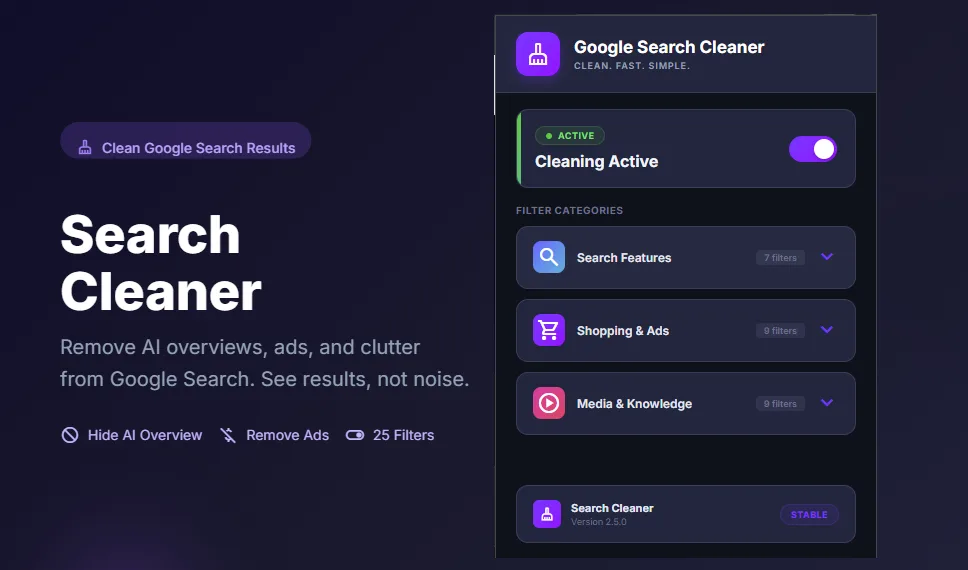
When you want plain results on Google, use the Web filter or Search Cleaner to hide AI Overviews. See Perplexity vs Google.