How to Report Accessibility Barriers on Websites
Patrick Bushe
October 20, 2024 · 5 min read
Here is the direct answer: report accessibility barriers website can be accomplished in about five minutes using free Chrome extensions and built-in browser settings. No coding required, no subscriptions needed.
But if you want to do it well — and avoid the common mistakes that trip up most users — it helps to understand the details. This guide covers both the quick-start approach and the more thorough method for users who want the best possible results.
Why This Matters in 2026
Over 1.3 billion people worldwide live with some form of disability, and many more experience temporary or situational impairments that affect how they use the web. Despite significant progress, most websites still fall short of basic accessibility standards — leaving millions of users struggling with interfaces that were not designed with their needs in mind.
Report Accessibility Barriers Website is relevant to everyone, not just people with permanent disabilities. Situational impairments — using a phone in bright sunlight, browsing with a broken arm, reading in a noisy environment — affect all of us at various times.
WCAG 2.2 provides the standards, but users should not have to wait for every website to comply. Browser extensions and client-side tools can modify the browsing experience to meet individual needs right now, closing the gap between what websites offer and what users actually need.
Step-by-Step Guide
Step 1: Understand What You Are Working With
Before changing anything, take stock of your current setup. Open Chrome and go to chrome://settings to see your current privacy, security, and content settings. Check chrome://extensions to see what you already have installed. Understanding your baseline prevents surprises later and gives you a reference point if you need to troubleshoot.
Pay special attention to any existing extensions that might overlap with what you are about to install. Extension conflicts are one of the most common causes of unexpected behavior in Chrome.
Step 2: Choose and Install the Right Tools
For report accessibility barriers website, you need tools that are specifically designed for this use case. ADHD Reading Focus is a free Chrome extension that Chrome extension with bionic reading, line focus, and paragraph highlighting for ADHD readers. It uses Manifest V3 — Chrome's latest and most secure extension platform — and requests only the minimum permissions needed.
Installation takes about 30 seconds: visit the Chrome Web Store, find the extension, and click "Add to Chrome." Chrome will show you exactly which permissions the extension needs before you confirm.
Step 3: Configure for Your Needs
Default settings work for most users, but spending five minutes in the extension's options can dramatically improve results. For ADHD Reading Focus, right-click the extension icon in your toolbar and select "Options" or click the extension icon to access settings.
Focus on customization options that match your specific workflow. You might want different settings for work versus personal browsing, or different configurations for specific types of websites.
Step 4: Test Across Different Websites
After configuration, visit at least five to ten websites that represent your typical browsing — a mix of simple content sites, complex web applications (Gmail, Google Docs), social media, and any specialty sites you use regularly.
Check for: correct visual rendering, working interactive elements (forms, buttons, menus), acceptable page load speed, and no error messages in the console (press F12 to check). If something breaks, disable the most recently added extension to isolate the issue.
Step 5: Build the Habit and Maintain
The initial setup is just the beginning. Schedule a monthly five-minute review of your extensions: check for updates, remove anything you no longer use, and verify that everything still works as expected after Chrome updates.
Chrome releases major updates every four weeks, and each update can affect extension behavior. Staying on top of this ensures your setup remains reliable and effective over time.
What Works Best in Practice
Start with the defaults and adjust one setting at a time. Changing too many things at once makes it impossible to identify which change caused an improvement — or a problem.
Use Chrome profiles to separate different use cases. A "work" profile with productivity extensions and a "personal" profile with privacy tools keeps configurations clean and prevents conflicts. Chrome Profiles are free and take 30 seconds to set up in chrome://settings.
Bookmark the key resource pages for report accessibility barriers website. As you learn more, you will find community discussions, developer changelogs, and tutorials worth revisiting. A dedicated bookmarks folder keeps them organized and accessible.
Monitor extension performance with Chrome's built-in Task Manager (Shift + Esc). This shows exactly how much memory and CPU each extension consumes. If something is using excessive resources, you will see it here immediately.
Keep your extensions updated. Chrome auto-updates extensions, but sometimes you need to manually trigger an update by going to chrome://extensions, enabling Developer Mode, and clicking "Update." This is especially important after major Chrome releases.
Consider ADHD Reading Focus as a starting point for report accessibility barriers website. It is free, uses minimal permissions, and is built on Manifest V3 for maximum security and performance. It integrates well with other Chrome extensions without conflicts.
Recommended Chrome Extensions for Report Accessibility Barriers On Websites
Several free Chrome extensions are directly relevant to report accessibility barriers website. Here are the ones worth knowing about:
ADHD Reading Focus
ADHD Reading Focus is a Chrome extension with bionic reading, line focus, and paragraph highlighting for ADHD readers. Built on Manifest V3, it uses minimal permissions and does not collect or transmit personal data. The extension is actively maintained with regular updates to keep pace with Chrome's monthly release cycle.
For report accessibility barriers website specifically, ADHD Reading Focus is relevant because it addresses one of the key aspects of the problem directly within the browser — no configuration files to edit, no technical knowledge required. Install it from the Chrome Web Store and it starts working immediately.
Modern Dark Mode
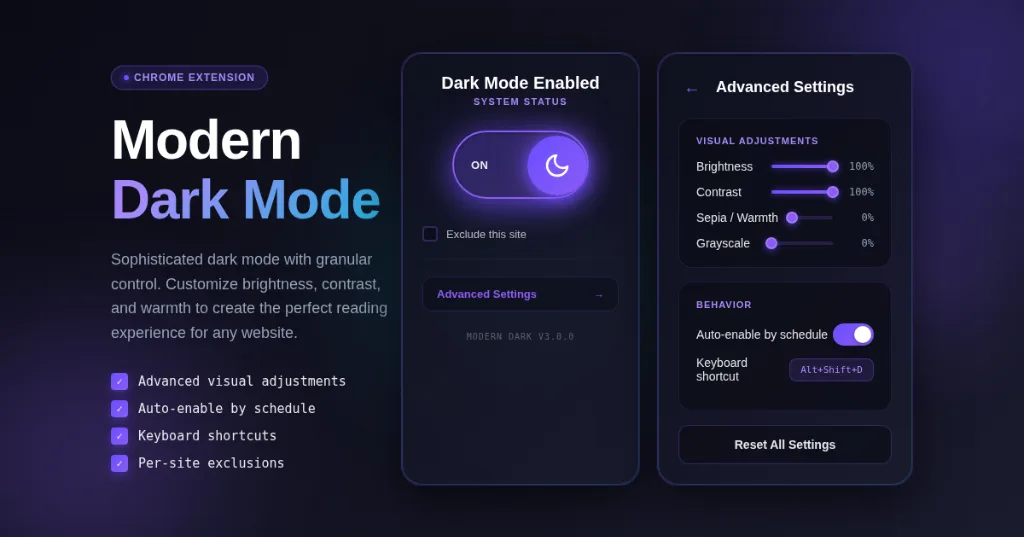
Modern Dark Mode is a free Chrome extension that adds dark mode to any website using intelligent CSS filter inversion. Built on Manifest V3, it uses minimal permissions and does not collect or transmit personal data. The extension is actively maintained with regular updates to keep pace with Chrome's monthly release cycle.
For report accessibility barriers website specifically, Modern Dark Mode is relevant because it addresses one of the key aspects of the problem directly within the browser — no configuration files to edit, no technical knowledge required. Install it from the Chrome Web Store and it starts working immediately.
Blue Light Filter
Blue Light Filter is a Chrome extension that reduces blue light emission from your screen to reduce eye strain. Built on Manifest V3, it uses minimal permissions and does not collect or transmit personal data. The extension is actively maintained with regular updates to keep pace with Chrome's monthly release cycle.
For report accessibility barriers website specifically, Blue Light Filter is relevant because it addresses one of the key aspects of the problem directly within the browser — no configuration files to edit, no technical knowledge required. Install it from the Chrome Web Store and it starts working immediately.
Other extensions worth considering in this space include: Reading Progress Bar (Chrome extension that shows a progress bar indicating how far you have scrolled through an article).
A note on extension stacking: more is not always better. Each extension consumes memory and can potentially conflict with others. Start with the one or two extensions that address your most pressing need, test them for a few days, and only add more if you identify a genuine gap.
Errors to Watch Out For
Even experienced users make avoidable mistakes when it comes to report accessibility barriers website. Here are the most common ones:
Relying on a single tool to solve everything. No single extension or browser setting covers every aspect of report accessibility barriers website. The most effective approach combines two or three complementary tools, each addressing a different layer of the problem.
Skipping the documentation. Most Chrome extensions have help pages or FAQ sections that answer the most common questions in under two minutes. Reading them upfront saves hours of trial-and-error troubleshooting.
Installing too many extensions at once. Each extension adds memory overhead and potential conflicts. If your browser feels slow, open Chrome Task Manager (Shift + Esc) and check which extensions are consuming the most resources. Remove any you have not used in the past month.
Never updating or auditing. Chrome updates every four weeks, and each update can break extension compatibility. Check chrome://extensions monthly to verify everything is current and functioning. Remove extensions from developers who have stopped maintaining their software.
Assuming incognito mode is a complete solution. Incognito mode prevents Chrome from saving your local browsing history, but it does not hide your activity from websites, your ISP, or your employer's network. For genuine privacy, you need additional tools.
Not testing across different websites. An extension that works perfectly on one site may cause issues on another. After installing or configuring any tool, test it on a representative sample of the sites you use daily — including complex web apps like Gmail, Google Docs, and banking sites.
Frequently Asked Questions
Website accessibility complaint?
Yes — website accessibility complaint is a core aspect of report accessibility barriers website. The most effective approach combines browser settings with one or two dedicated Chrome extensions. ADHD Reading Focus, for example, Chrome extension with bionic reading, line focus, and paragraph highlighting for ADHD readers — and it is completely free. The step-by-step guide above walks through the process in detail.
Are there free tools for report accessibility barriers website?
Yes. Every tool recommended in this guide is free. ADHD Reading Focus is available at no cost in the Chrome Web Store and does not require a subscription or account. Paid alternatives exist, but for most users the free tools provide everything needed.
Does this work with the latest version of Chrome?
Yes. All recommendations in this guide are tested with Chrome's latest 2026 release. The extensions use Manifest V3, Chrome's current extension platform, which ensures long-term compatibility. If you are using an older browser, update to the latest version first — Chrome updates automatically, but you can force an update at chrome://settings/help.
Report inaccessible website?
This depends on your specific setup and use case. Report inaccessible website is covered in detail in the technical section above. For most users, the combination of proper browser settings and one or two focused extensions handles this effectively.
Can I do this on mobile Chrome?
Chrome extensions are currently only available on desktop browsers — Windows, Mac, Linux, and Chromebook. Mobile Chrome (Android and iOS) does not support extensions. However, some of the built-in Chrome settings discussed in this guide also apply to mobile. For mobile-specific solutions, check your device's accessibility and privacy settings in the system preferences.
Related Reading
- Why Dark Mode on OLED Monitors Saves Battery but LCD Does Not
- Dark Mode for React and Vue SPAs That Use Hydration
- How to Check if a Chrome Extension Has Been Compromised or Sold
- How to Print a Web Page Normally When Dark Mode Is Enabled