Dark Mode vs Light Mode for Productivity: What Studies Actually Show
PB
Patrick Bushe
September 17, 2025 · 5 min read
For reading and detailed work in a normally lit room, research generally favors light mode: dark text on a light background tends to be read a little more accurately, especially at small sizes. Dark mode has real advantages in dim rooms and for comfort, and for some people with certain eye conditions. The best choice depends on your room, your eyes and the task.
What reading studies generally find
- Light mode helps accuracy. Studies of proofreading and reading tasks have repeatedly found better performance with dark text on light backgrounds. A brighter screen makes the pupil smaller, which sharpens focus a bit, like a camera's aperture.
- The difference is small. For everyday reading at a comfortable size, most people won't notice it.
- Dark mode isn't proven to reduce eye strain. Comfort comes more from brightness that matches the room, breaks and blinking than from the color scheme.
When light mode wins
- Bright rooms and daylight, where a dark screen reflects more glare and looks washed out.
- Proofreading, spreadsheets and other detail work.
- People with astigmatism, for whom light text on a black background can look blurry or halo-like.
When dark mode wins
- Dim rooms and night work, where a bright white screen is uncomfortable.
- Glancing between screens and notes, or working alongside others in a dark room.
- Some people with light sensitivity, migraines or certain eye conditions find it more comfortable.
- Battery life on OLED screens, where dark pixels use less power.
Is dark mode better for studying?
If you study in the evening in a dim room, dark mode is often more comfortable. For daytime studying and careful reading, light mode with a slightly lower brightness is likely better. Many people switch by time of day, which gets the best of both.
How to switch automatically
- Set your system to change themes at sunset (macOS and Android have this built in; Windows needs a scheduled task or an app).
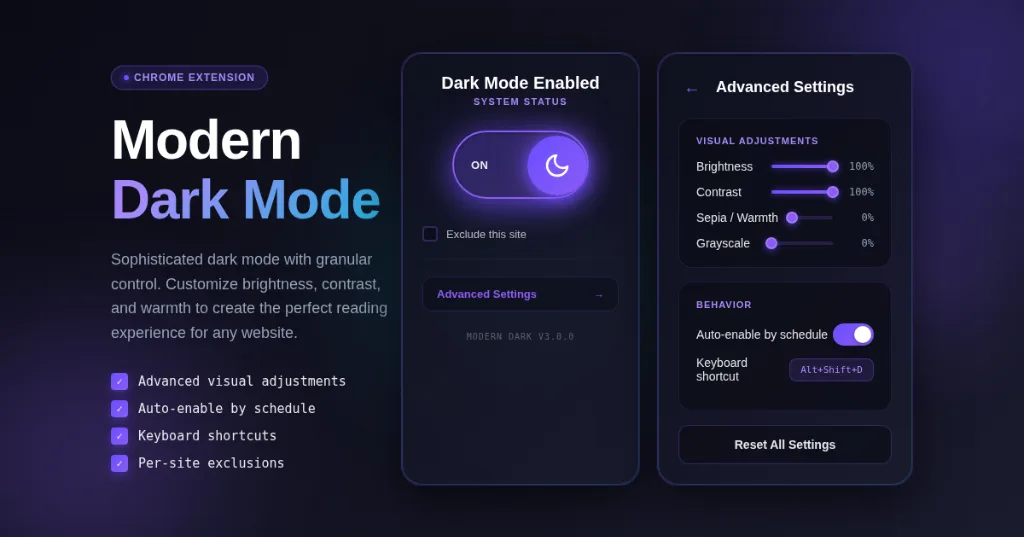
- In Chrome, Modern Dark Mode has an on/off schedule, so websites go dark in the evening and back to normal in the morning, with photos kept in their real colors.
Making either mode easier on the eyes
- Match screen brightness to the room. See ideal monitor brightness in a dark room.
- Avoid pure white on pure black or the reverse at full brightness; slightly softer contrast is easier for long sessions.
- Make text bigger rather than squinting.
- Take breaks every 20 minutes or so.