How Browser Extensions Will Evolve in the Age of AI Assistants
Patrick Bushe
July 8, 2024 · 5 min read
AI assistants are moving into the browser itself, and that's changing what extensions are for. Some extension types will fade as browsers absorb them; others will grow. Here's what's already happening and what it likely means.
Browsers are absorbing simple AI features
Chrome has Gemini built in for many users, and Edge has Copilot. Summarizing a page, explaining a passage or drafting a reply no longer needs an extension. Single-purpose AI wrappers, extensions that only send page text to a chatbot, face the toughest future.
On-device AI for extensions
Chrome has begun shipping built-in AI APIs that run on your own computer, such as summarizing, translating and detecting the language of text. Extensions can use them without sending data to a server. Expect more extensions with AI features that stay private and work offline.
Agents that act for you
A newer kind of extension lets an AI navigate sites, fill forms and click buttons on your behalf. These are powerful and still early: they make mistakes and need supervision. See how AI assistants use extensions today.
Security will matter more
- Prompt injection: web pages can hide instructions aimed at AI tools. Extensions that let AI act need strong limits on what it can do without asking.
- Permissions: AI extensions often need to read every page. Expect closer review and clearer permission prompts. See extension permissions explained.
- Fake AI extensions already pose as popular tools to steal data.
What stays useful
Extensions that do one job reliably, without AI, keep their place: blocking, tidying, measuring and automating predictable tasks. They're fast, private and predictable in a way a general assistant isn't. Manifest V3 already shapes what they can do. See what Manifest V3 changed.
Tools that remove AI
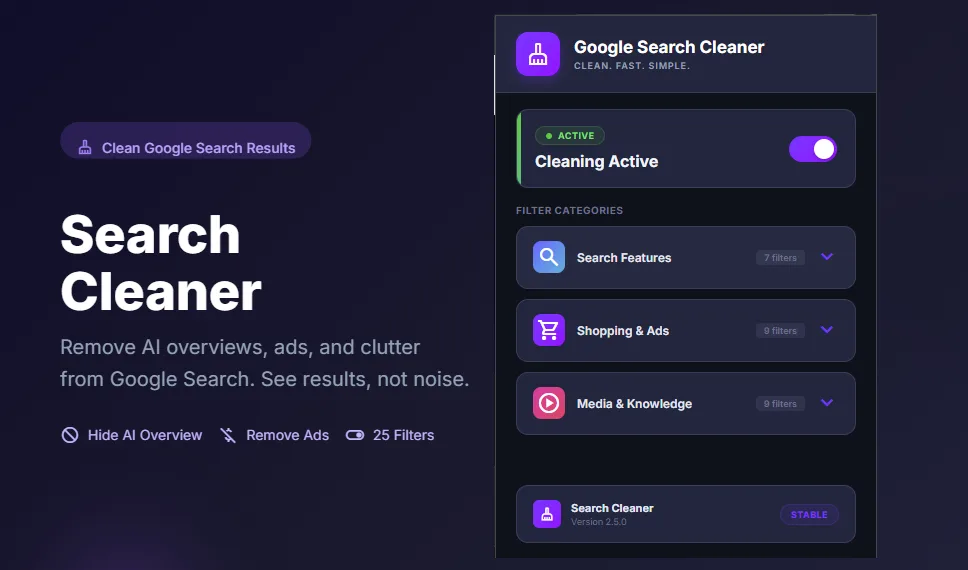
As AI fills more of the web, some people want less of it. Search Cleaner hides the Google sections you choose, including AI Overviews and the AI Mode tab, for a page of plain links. Expect more tools that give people control over where AI appears.
Likely changes
- Fewer general AI extensions; more specialized ones built for one job or industry.
- More AI features that run on your device.
- Stricter store rules for extensions that let AI take actions.
- More choice for people who'd rather turn AI off.
What to do now
- Review your extensions and remove AI tools you no longer use.
- Prefer tools that explain what data they send and where.
- Check each AI tool's training and data settings. See using AI tools privately.