How Split Screen Setups Affect Eye Movement and Fatigue
PB
Patrick Bushe
September 3, 2025 · 5 min read
Two screens, or two windows side by side, can make work faster. They also mean more turning of your head and eyes, more refocusing and, if the screens don't match, more adjusting to different brightness. A good setup removes most of that extra effort.
What makes split setups tiring
- Turning: repeatedly looking to a screen off to the side strains the neck more than looking straight ahead.
- Refocusing: screens at different distances make your eyes change focus each time you switch.
- Brightness jumps: one bright and one dim screen make your eyes readjust every time.
- Different text sizes: switching between large and tiny text means leaning in and out.
Arrange the screens
- One main screen: put it directly in front of you, with the second angled beside it.
- Equal use: if you use both equally, center the gap between them on your nose and angle both inward slightly.
- Same height and distance: tops at or slightly below eye level, both about an arm's length away.
- Laptop plus monitor: raise the laptop to the monitor's height, or use it only for occasional tasks.
Match the screens
- Set both to similar brightness and color temperature with their own buttons or settings. Free tools such as Monitorian or Twinkle Tray on Windows adjust external monitor brightness from the taskbar.
- Use the same scaling, so text appears a similar size on both.
- Use the same theme on both, dark or light, so you're not switching between extremes.
For split windows on one screen
- Put the window you read most on the side you naturally look at.
- Avoid very wide windows of text; long lines are hard to follow.
- Zoom each window so text is comfortable, rather than squeezing everything in.
Browser settings
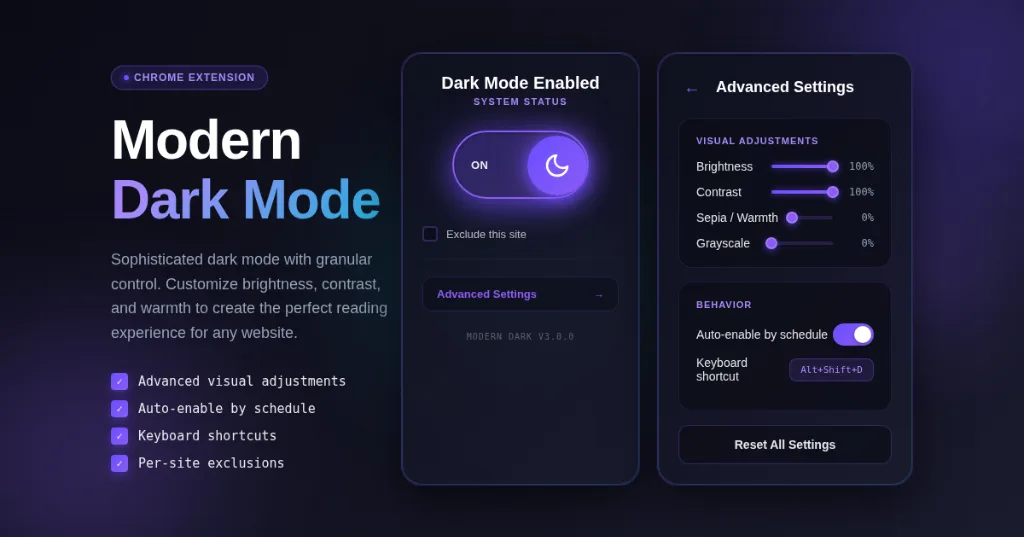
- Modern Dark Mode darkens bright web pages, so a browser window doesn't glare next to darker apps.
- Blue Light Filter warms web pages in the evening. It only affects pages in Chrome, so use your system's night light setting to warm both screens evenly.
For more, see dark mode on dual monitors and multi-monitor ergonomics.
Take breaks
More screens means more screen time. Look away into the distance regularly, and stand up every hour or so. See the 20-20-20 rule.