How to Fact-Check AI Answers Using Web Archives and Search
Patrick Bushe
July 7, 2024 · 5 min read
AI chatbots and AI search answers are fluent and confident, and sometimes wrong. They can misread sources, mix up details, or invent facts and citations that don't exist. In 2023, lawyers in the US case Mata v. Avianca were fined after filing a brief with court cases ChatGPT had made up. Checking an AI answer takes a few minutes and a clear routine.
1. Check that the sources exist
- Click every link the answer cites. Does it load? Is it the page the AI described?
- For books, papers and cases without links, search for the exact title in quotes. If nothing comes up, treat it as invented.
- Check that the source actually says what the AI claims. Misquoting a real source is as common as inventing one.
2. Trace the claim to its origin
A news article may report a study; the AI may summarize the article. Follow the chain back to the original: the study, the official statistics, the company's announcement. Details often change at each step.
3. Read laterally
Fact-checkers use a method called SIFT, developed by Mike Caulfield: Stop, Investigate the source, Find better coverage, and Trace claims to the original. Instead of reading one page deeply, open new tabs to see what other sources say about the claim and about the source itself.
4. Use web archives for pages that changed
Sometimes an AI answer is based on an old version of a page, or a cited page has since been edited or removed. The Wayback Machine shows what the page said on earlier dates. Wayback Quick Access opens the capture list for the page you're on, and saves a fresh copy in one click. See verifying claims with web archives.
5. Check dates
AI models are trained on data up to a cut-off, and search-based answers may pull old pages. For prices, laws, schedules and anything fast-changing, find a current official source.
6. Be extra careful with
- Health, legal and financial advice.
- Numbers and statistics, especially precise ones.
- Quotes attributed to real people.
- Recent events.
Search without the AI layer
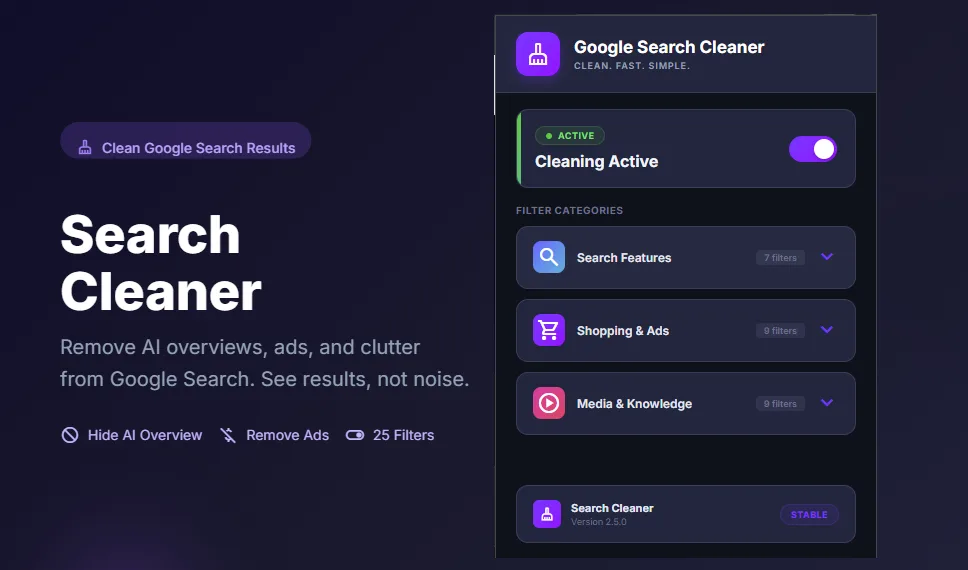
To compare an AI answer with ordinary results, use Google's Web filter, or Search Cleaner to hide AI Overviews and the AI Mode tab. See how AI Overviews get answers wrong.
Use AI as a starting point
AI answers are useful for finding terms, ideas and sources to check. Treat them as a lead, not the final word. See how AI summaries affect critical thinking.