Best Monitor Settings for People Who Work 10 Plus Hours a Day on Screens
Patrick Bushe
September 23, 2025 · 5 min read
If you spend ten or more hours a day at a screen, small settings add up. The aim isn't the most vivid picture; it's a screen your eyes can look at all day without working hard.
Brightness: match the room
This is the setting that matters most. The screen should look about as bright as a sheet of white paper on your desk. Too bright in a dim room feels harsh; too dim in a bright room makes you squint. Adjust it as daylight changes, or use auto-brightness on laptops. See ideal brightness for a dark room.
Contrast and picture mode
- Leave contrast near its default; very high contrast makes white areas glare.
- Choose a "Standard", "sRGB" or "Office" mode rather than "Vivid", "Dynamic" or "Game".
- Turn off dynamic contrast and eco modes that change brightness on their own, which can be distracting.
Color temperature
- During the day, a neutral setting, often called 6500K, looks natural.
- In the evening, use Night Light on Windows or Night Shift on Mac to warm the whole screen.
- Blue Light Filter warms web pages in Chrome on a schedule, if you want pages warmer than the rest of the screen.
Text size and scaling
You shouldn't need to lean in. Increase Windows display scaling or macOS's "Larger text" setting until body text is comfortable from your normal sitting position, and zoom individual websites if needed.
Refresh rate and flicker
- A higher refresh rate, such as 120Hz or more, makes scrolling smoother, which some people find easier to follow. See refresh rate and eye strain.
- Some screens flicker at low brightness to dim themselves. If you're sensitive to it, look for monitors described as flicker-free.
Dark or light
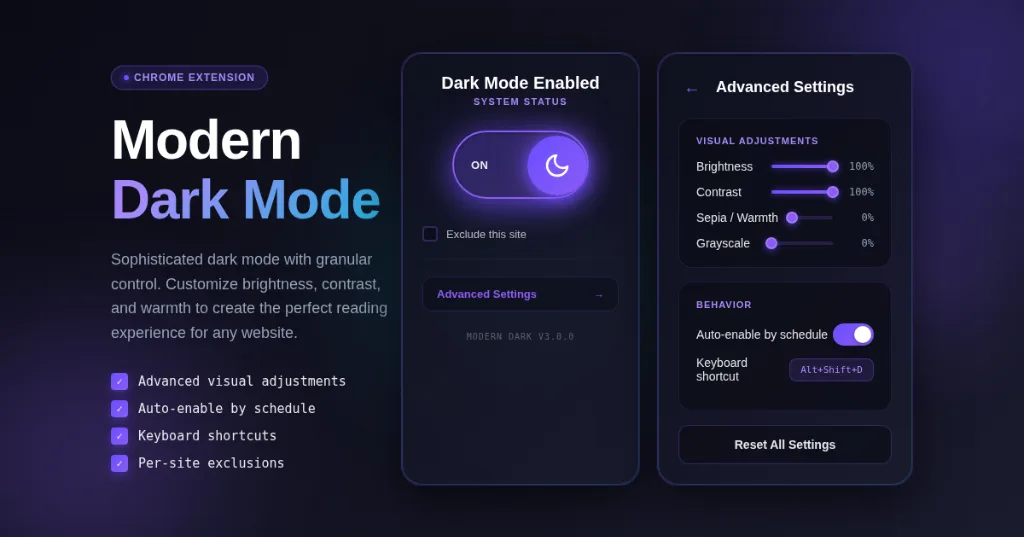
Use whichever is more comfortable in your lighting. Dark themes suit dim rooms; light themes are often clearer in bright ones. Modern Dark Mode darkens web pages that don't have their own dark theme.
Position
- About an arm's length away.
- Top of the screen at or slightly below eye level.
- Tilted back slightly, with windows to the side rather than behind you or the screen.
Settings won't replace breaks
Over a long day, breaks matter as much as any setting. Look into the distance regularly and stand up every hour. See the 20-20-20 rule. If your eyes still hurt, get an eye exam; glasses for screen distance can make a big difference.