How PWM Flicker in Monitors Causes Headaches and How to Avoid It
Patrick Bushe
September 5, 2025 · 5 min read
Many screens dim by switching their light on and off very fast, a method called pulse-width modulation (PWM). You don't see the flicker, but some people's eyes and brains react to it, with headaches, eye strain or a vague tired feeling. If dim screens bother you more than bright ones, PWM is a likely cause.
How PWM works
To look dimmer, the backlight (on LCDs) or the pixels (on OLEDs) spend more of each cycle switched off. At high brightness they're on almost all the time, so there's little flicker. At low brightness they're off for most of each cycle, and the flicker is strongest. Faster PWM is easier to tolerate than slow PWM.
Why it can cause headaches
Even when flicker is too fast to notice, it can still affect how your eyes adjust and how your visual system processes the image. Sensitivity varies a lot: many people never notice anything, while others get headaches within an hour on certain screens. People prone to migraines often report being more sensitive.
How to check your screen
- Camera test: set the screen to low brightness and point a phone camera at it, ideally in slow-motion video. Dark bands rolling across the image suggest PWM.
- Pencil test: wave a pencil quickly in front of a bright part of the screen. Several separate copies of the pencil, instead of a smooth blur, can mean flicker.
- Reviews: sites such as RTINGS and Notebookcheck measure flicker and PWM frequency for many monitors, laptops and phones.
How to avoid it
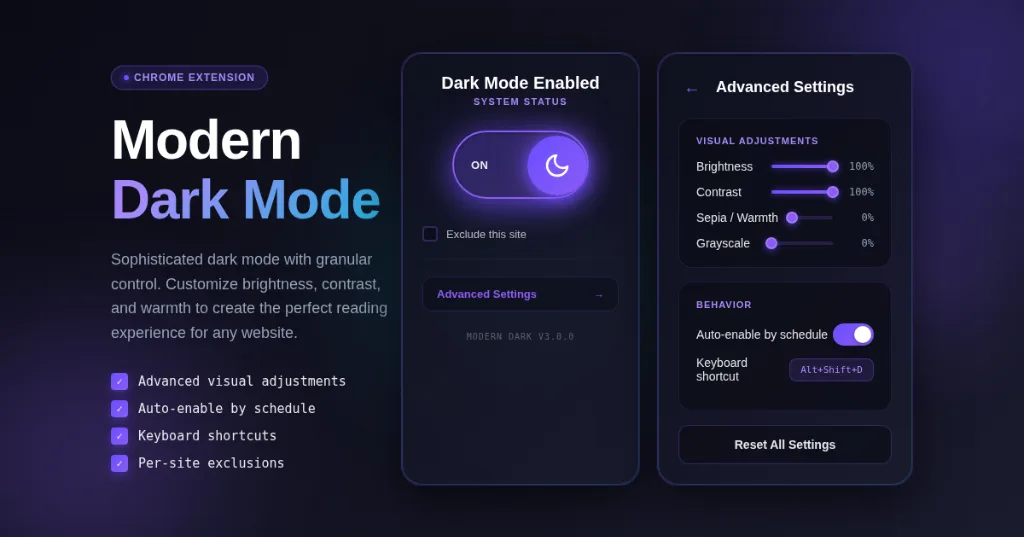
- Keep the brightness up and dim the picture another way. Since flicker is worst at low backlight levels, set the screen brighter and reduce the brightness of what's shown instead: use dark mode, lower the contrast, or dim content in software. Inside Chrome, Modern Dark Mode's brightness slider and Blue Light Filter's overlay both dim web pages without lowering the backlight.
- Use DC dimming if your phone has it, often under display or developer settings, which dims without flicker at the cost of some color accuracy at low brightness.
- Buy flicker-free. Many monitors are sold as "flicker-free", and some carry a third-party flicker-free certification. Check reviews that measure it.
- Light the room so you don't need a very dim screen. See ideal monitor brightness in a dark room.
If headaches continue
Screens are only one possible cause. Long sessions without breaks, an out-of-date glasses prescription, dry eyes, posture and lighting all contribute. Take regular breaks, and see an eye doctor if headaches keep coming back.